
- Similar performance or relative joint contributions can conceal different absolute mechanical demands.
- Near-symmetric hop distance after ACL reconstruction can mask reduced reconstructed-knee propulsion work.
- Net joint moments and work are not ligament loads; prognostic screening findings remain inconsistent.
- Multicomponent neuromuscular programmes have prevention evidence and do not require a validated personal-risk label for access.
- Un rendimiento similar o contribuciones articulares relativas similares pueden ocultar demandas mecánicas absolutas diferentes.
- Una distancia de salto casi simétrica tras la reconstrucción del LCA puede enmascarar un menor trabajo propulsivo de la rodilla reconstruida.
- Los momentos y el trabajo articulares netos no son cargas ligamentosas; los hallazgos pronósticos del cribado siguen siendo inconsistentes.
- Los programas neuromusculares multicomponente cuentan con evidencia preventiva y no requieren una etiqueta de riesgo personal validada para acceder a ellos.
- قد يُخفي الأداء المتشابه أو المساهمات المفصلية النسبية المتشابهة متطلباتٍ ميكانيكية مطلقة مختلفة.
- قد تُخفي مسافةُ القفز شبه المتناظرة بعد إعادة بناء الرباط الصليبي الأمامي انخفاضَ شغل الدفع في الركبة المُعاد بناؤها.
- العزوم والشغل المفصلية الصافية ليست أحمالًا على الرباط؛ ولا تزال نتائج الفحص التنبؤي غير متسقة.
- تمتلك برامج التدريب العصبي العضلي متعددة المكونات أدلةً وقائية، ولا يتطلب الوصول إليها تصنيفًا مُتحقَّقًا منه للخطر الفردي.
- समान प्रदर्शन या समान सापेक्ष संधि-योगदान भिन्न निरपेक्ष यांत्रिक माँगों को छिपा सकते हैं।
- ACL पुनर्निर्माण के बाद लगभग सममित हॉप-दूरी पुनर्निर्मित घुटने के कम प्रणोदन-कार्य को ढक सकती है।
- शुद्ध संधि-आघूर्ण और कार्य लिगामेंट-भार नहीं हैं; पूर्वानुमान संबंधी स्क्रीनिंग-निष्कर्ष अब भी असंगत हैं।
- बहुघटकीय न्यूरोमस्कुलर कार्यक्रमों के पक्ष में निवारण-साक्ष्य है, और उनमें भाग लेने के लिए किसी सत्यापित व्यक्तिगत-जोखिम लेबल की आवश्यकता नहीं है।
IntroductionIntroducciónالمقدمةपरिचय
Landing requires the athlete to redirect whole-body momentum while preparing for the next action. The lower limbs and trunk contribute to this solution, and a satisfactory performance outcome can be achieved through several combinations of joint motion and net mechanical work. A knee measure is therefore one observation within a coordinated task. Its usefulness depends on the question being asked: describing a strategy, identifying a rehabilitation deficit, investigating an injury mechanism or estimating a future outcome. Treating these questions as interchangeable weakens both research and clinical communication.
The 2025 Female, woman and/or girl Athlete Injury pRevention (FAIR) consensus situates prevention within training, implementation and supportive sporting environments [1]. This broader perspective is compatible with detailed biomechanics, provided that a measured movement pattern is not treated as the sole determinant of injury. A 2026 experiment comparing vertical and lateral drop jumps in female athletes further illustrates the distinction between absolute mechanical demands and the proportions attributed to individual joints [2]. Together, these developments motivate a framework that connects mechanical observations to the strength and type of evidence required for a practical decision.
This review examines landing and closely related hopping tasks, with particular emphasis on anterior cruciate ligament (ACL) injury and rehabilitation. The central proposition is that whole limb assessment becomes useful when the task, variable and intended inference are specified together. More variables do not automatically produce a more accurate injury forecast. A clinically valuable measurement may instead reveal how an athlete achieves a task and whether an identified deficit changes during rehabilitation.
Evidence identification and critical appraisalIdentificación de la evidencia y evaluación críticaتحديد الأدلة والتقييم النقديसाक्ष्य की पहचान और समालोचनात्मक मूल्यांकन
This critical narrative review used purposive evidence selection. The update completed on 10 November 2026 used targeted web searches to locate PubMed records, publisher pages and publicly accessible full texts. Searches combined female athletes or women with landing biomechanics, joint work, ACL injury, prospective screening, fatigue, neuromuscular prevention, measurement reliability and return to sport. Exact-title and DOI searches were also used to verify foundational papers, recent studies and linked corrections. Citation trails from pivotal papers were checked for relevant mechanical and methodological work.
Priority was given to original experiments, prospective cohorts and controlled prevention trials that could resolve a specific interpretive question. Consensus and methodological publications were included for measurement definitions, prediction-model appraisal, female participant research and injury surveillance. A recent systematic review was used to contextualise task anticipation. Female cohorts were prioritised; male or mixed cohorts were retained only when their contribution and limits were explicit. Studies did not need to support the review’s central argument to be included. The contrast between early prognostic findings and later negative or corrected results was deliberately examined.
Appraisal considered design, sample and event counts, task specificity, construct validity, statistical uncertainty and the difference between measured outcomes and the authors’ explanations. Available full texts informed pivotal cohort, trial and modelling interpretations. When only an abstract was accessible, conclusions were confined to information explicitly reported there; the 2026 directional drop-jump study is one such source. The search was not exhaustive, screening was not duplicated, no prospectively registered review protocol was used, and no formal risk-of-bias score or certainty grade was assigned. The tables are interpretive summaries, not a complete evidence inventory or a new validated assessment instrument.
Mechanical quantities and their interpretationMagnitudes mecánicas y su interpretaciónالكميات الميكانيكية وتفسيرهاयांत्रिक मात्राएँ और उनकी व्याख्या
3.1External force and whole-body momentumFuerza externa y cantidad de movimiento del cuerpo enteroالقوة الخارجية وزخم الجسم كاملًاबाहरी बल और संपूर्ण-शरीर संवेग
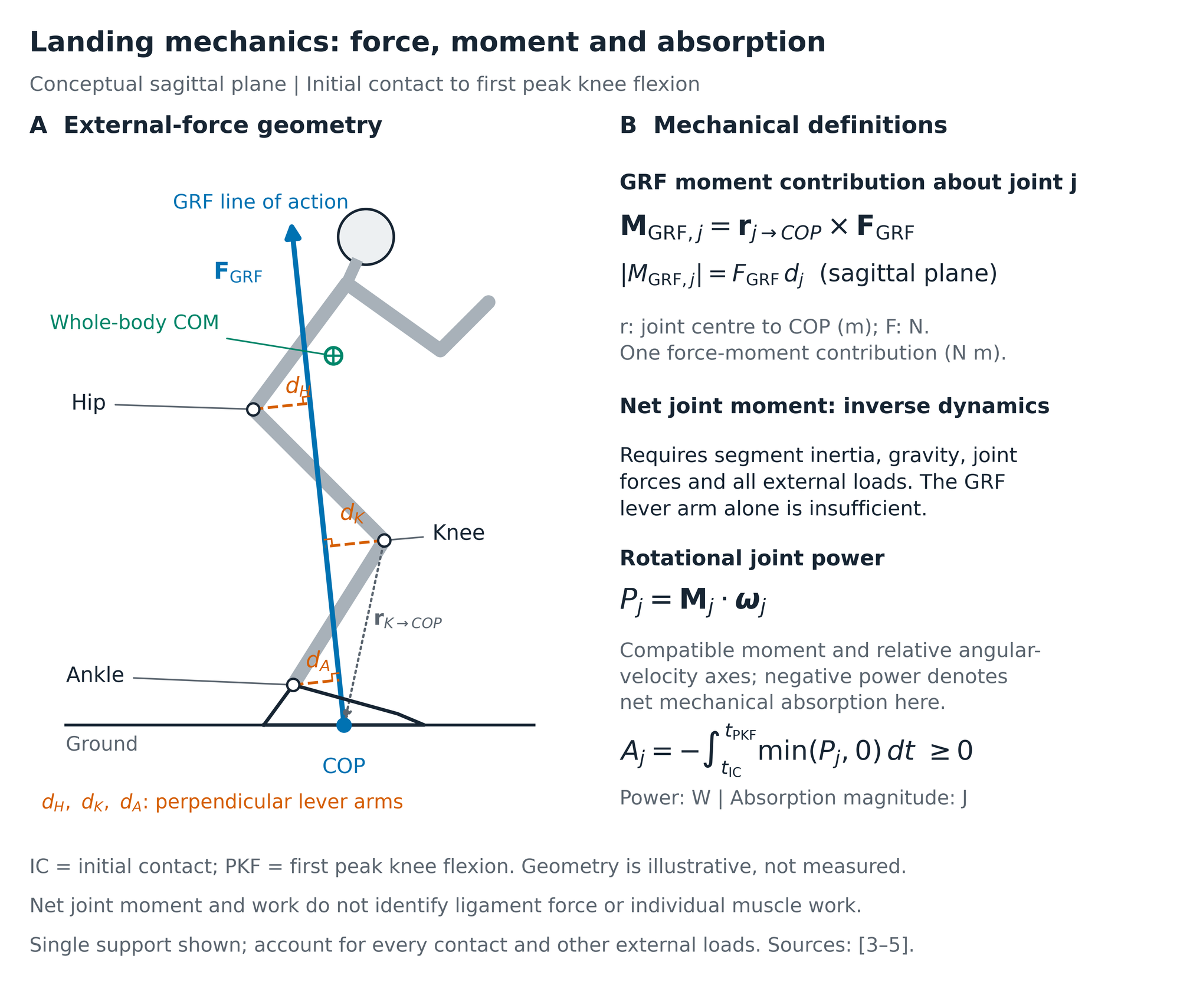
Ground-reaction force describes the interaction between the athlete and the support surface. For an athlete contacting the ground without additional external support, whole-body linear momentum satisfies
Here, is body mass, is centre-of-mass velocity, is gravitational acceleration, and the summation includes every ground contact. Other external forces must be included when present. Integrating vertical force without subtracting body weight does not yield net vertical impulse. During bilateral landing, a single force plate under one foot cannot by itself describe the whole-body impulse unless the other contact is also accounted for.
Peak force and impulse answer different questions. Peak force characterises an instant, whereas net impulse governs momentum change over an interval. Similar impulses can occur with different peak forces and contact times. Likewise, a lower peak force is not automatically evidence of reduced knee demand: force direction, centre of pressure, body configuration and the movement that follows contact all matter. The force plate measures an external interaction, not the force in the ACL.
3.2Net moments and rotational joint workMomentos netos y trabajo articular rotacionalالعزوم الصافية والشغل المفصلي الدورانيशुद्ध आघूर्ण और घूर्णी संधि-कार्य
Inverse dynamics combines external forces, segment motion and inertial properties to estimate net joint moments. A net moment represents the combined mechanical action of muscles, passive tissues and joint constraints within the model. It does not identify a unique muscle-force solution or a ligament load. Those estimates require additional assumptions and independent validation appropriate to their intended use [3]. Joint-coordinate systems, rotation sequences and whether moments are reported as internal or external must be explicit; standardisation guidance provides a basis for reporting these choices [4].
For rotational joint power, a consistently defined net moment and relative angular velocity give
The moment and relative angular velocity must use compatible axes and signs. Power is expressed in watts and work in joules. Under a convention in which negative power represents net absorption, a nonnegative absorption measure can be defined as
This separates the negative part of the power curve from positive work that could otherwise cancel it. A paper must state whether it reports signed net work, positive work, negative work or absorption magnitude, and specify the integration interval. Contact to peak knee flexion, contact to minimum centre-of-mass height and the entire stance phase are not interchangeable windows.
Net joint work is not the work of an individual muscle or tendon. Antagonist activity can partly cancel in a net moment, and biarticular structures can transfer energy between joints. Rotational power also omits translational terms when these are relevant to the model. Zelik and Honert demonstrate through analytical reasoning and walking case studies that treating the foot as a rigid segment can distort ankle and foot power estimates [5]. The methodological lesson is relevant to model selection, but the size of their walking effects should not be transferred numerically to athletic landing.
3.3Fractions require a visible denominatorLas fracciones requieren un denominador visibleتتطلب الكسور مقامًا ظاهرًاअंशों के लिए दृश्य हर (डिनॉमिनेटर) आवश्यक है
A relative absorption contribution could be defined as , where the denominator includes a prespecified set of joints in the same limb and interval. This fraction is meaningful only when the denominator is positive and the underlying quantities are compatible. It is not a support-moment contribution, muscle contribution or proportion of whole-body energy dissipation. Unmeasured foot deformation, soft-tissue motion and other segments can prevent the measured joint sum from representing the whole system.
An illustrative calculation shows why absolute and relative outcomes should be reported together. If knee absorption increases from 30 to 60 J while the measured joint total increases from 100 to 240 J, the knee fraction falls from 30% to 25% even though absolute knee absorption doubles. These numbers are arithmetic examples, not participant data. A change in the fraction alone cannot distinguish unloading from redistribution within a larger total demand. Table 1 summarises the main measurement boundaries.
| Quantity | Definition and units | Interpretation boundary |
|---|---|---|
| Ground-reaction force | External contact force in N | Does not directly measure internal tissue force |
| Net external impulse | Integral of all external forces in N s | Requires body weight and all contacts to be accounted for |
| Net joint moment | Inverse-dynamics estimate in N m | Does not identify an individual muscle or ligament force |
| Rotational joint power | Compatible moment and angular-velocity dot product in W | Depends on model, axes and sign convention |
| Joint work or absorption | Defined power integral in J | Signed net work and negative-work magnitude differ |
| Relative joint contribution | Specified numerator divided by specified total | Denominator changes can conceal absolute increases |
Figure 1 distinguishes external-force geometry, net joint moments and rotational absorption within an explicitly defined landing interval.
Whole limb experiments reveal hidden task strategiesLos experimentos con la extremidad completa revelan estrategias ocultas de la tareaتكشف تجارب الطرف كاملًا عن استراتيجيات مهمة خفيةसंपूर्ण-अंग प्रयोग छिपी कार्य-रणनीतियाँ उजागर करते हैं
Lin and Cannon assessed 18 female athletes during vertical and lateral drop jumps. Their abstract reports different absolute limb and joint demands but similar average hip, knee and ankle contributions to a study-defined three-dimensional support moment [2]. These findings support reporting absolute and relative quantities together. They do not establish an optimal distribution or show that the nervous system used an identical control process across conditions. In particular, absence of a statistically significant interaction is not a formal test of equivalence. The reported support-moment fractions should not be relabelled as joint-work fractions or energy-absorption percentages.
Hop studies provide a clinically relevant example of performance concealing joint strategy. Kotsifaki and colleagues studied 26 men after ACL reconstruction (ACLR) and 23 male controls. In the ACLR group, mean hop-distance symmetry was 97% while knee propulsion-work symmetry was approximately 69% [6]. The groups differed in age and activity level, and the experiment did not establish future injury causation. Its strongest contribution is demonstrating that symmetry in distance and symmetry in joint work are different constructs.
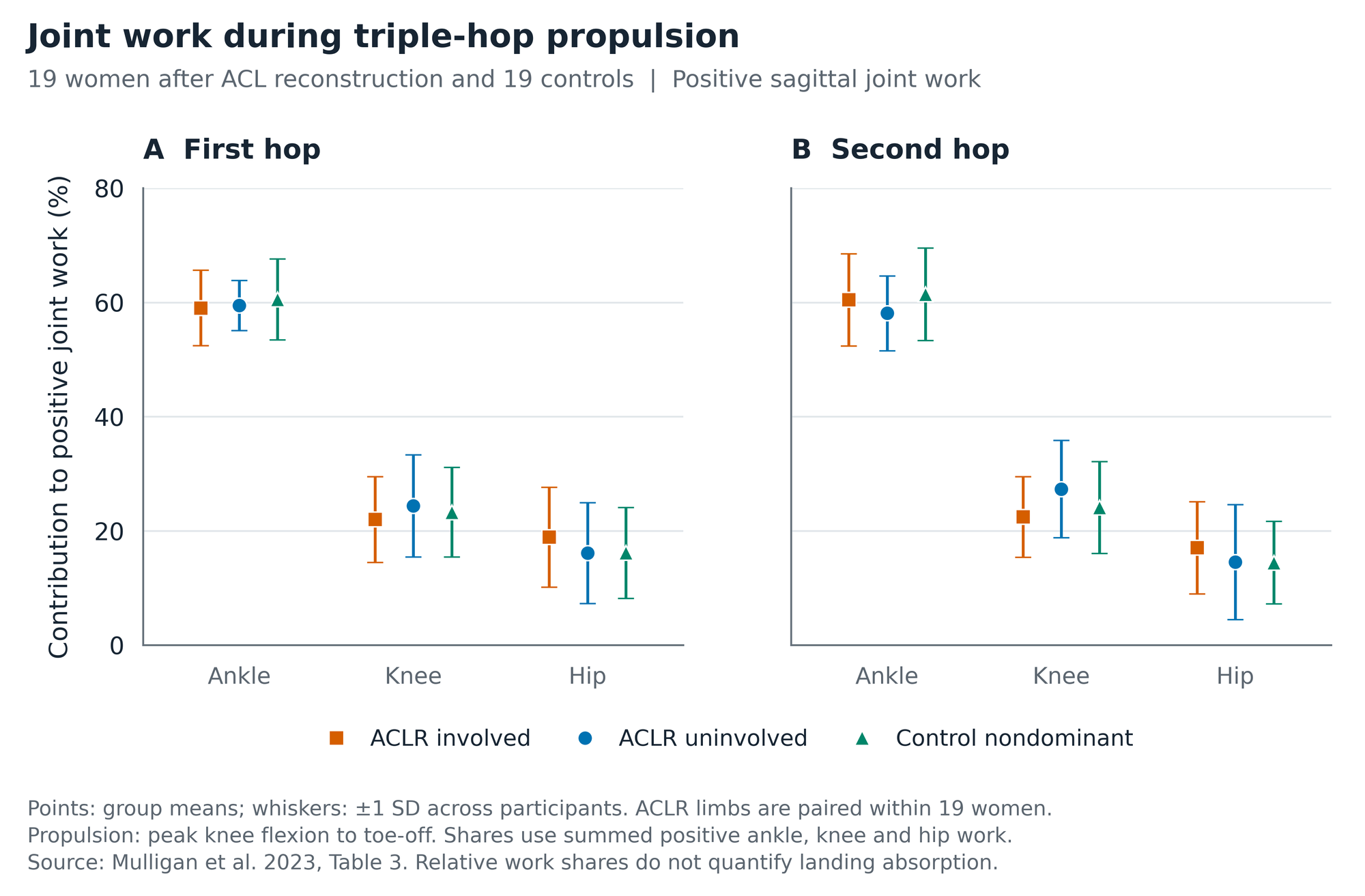
Direct evidence in women supports that distinction. Mulligan and colleagues compared 19 women after ACLR with 19 controls during a triple hop. Despite mean distance symmetry of approximately 96%, the reconstructed knee generated less propulsion work than the uninvolved knee [7]. The results concern the first two propulsive phases, not a universal landing deficit or a reinjury threshold. Across these studies, interpreting hop distance as a complete measure of knee recovery is difficult to justify, but performance remains useful when accompanied by an assessment of how it was achieved.
Joint-work contributions during triple-hop propulsion provide information beyond the achieved hop distance (Figure 2).
The comparison limb also requires scrutiny. Wellsandt and colleagues found that concurrent limb-symmetry measures could overestimate recovery relative to a presurgical measure of the uninvolved limb [8]. Presurgical function is itself not an actual preinjury baseline. Where feasible, interpretation should combine absolute performance, historical values, an appropriate reference group and bilateral measurements. A ratio approaching unity can reflect improvement of the involved limb, deterioration of the comparison limb, or both.
The trunk can change the configuration through which forces act. Blackburn and Padua experimentally increased trunk flexion during controlled drop landing and observed accompanying changes in hip and knee flexion [9]. This demonstrates coupling within the task, but it does not prove that maximal trunk flexion prevents ACL injury. Feedback should be evaluated against the intended movement goal, the next action and redistribution across joints. A cue that lowers one measured demand may alter balance, another joint’s demand or sport performance.
Tissue mechanisms do not establish personal injury probabilitiesLos mecanismos tisulares no establecen probabilidades individuales de lesiónالآليات النسيجية لا تُحدّد احتمالات الإصابة الفرديةऊतक-तंत्र व्यक्तिगत चोट-संभावनाएँ स्थापित नहीं करते
Direct measurements in selected rehabilitation activities show that ACL strain depends on knee position and muscle contraction conditions [10]. Cadaveric experiments similarly demonstrate that quadriceps and hamstring loading affect ACL force and knee kinematics [11]. These studies constrain mechanistic explanations, but their loading conditions differ from high-speed sport. They do not provide a conversion formula from a knee angle, an electromyographic amplitude or a force-plate peak to ligament strain during a competitive landing.
Surface electromyography can inform excitation timing and constrain a musculoskeletal model, but it is not a direct force measurement. Electrode placement, normalisation and the relationship between excitation, muscle length, contraction velocity and force affect interpretation. A mechanically coherent estimate can still have uncertainty in anatomy, material properties and force-sharing assumptions. Sensitivity analysis should identify which assumptions materially change a conclusion instead of treating a visually plausible simulation as independent validation [3].
Koga and colleagues reconstructed ten noncontact ACL injury events in female handball and basketball using video and model-based image matching [12]. Rapid multiplanar motion around the estimated injury period provides valuable mechanistic evidence from actual sport. However, video does not directly reveal microscopic rupture timing, and some observed motion may follow ligament failure. Without comparable noninjury exposures, the case series cannot estimate how often the same apparent movement occurs safely. A mechanism study and a prospective screening study therefore answer different questions.
Prospective association and screening performanceAsociación prospectiva y rendimiento del cribadoالارتباط الاستباقي وأداء الفحصभावी संबंध और स्क्रीनिंग-प्रदर्शन
The influential Hewett cohort measured 205 female athletes before a season, with nine subsequent ACL injuries, and reported associations involving knee posture and loading [13]. The small number of injuries limits precision and the stability of multivariable estimates. A later study of 710 elite female football and handball players recorded 42 noncontact ACL injuries and found poor screening performance for the vertical drop jump [14]. Its corrigendum corrected medial knee displacement and removed the association originally reported for that variable [15]. Interpretations must use the corrected result.
A mechanically plausible characteristic can discriminate poorly between future injured and uninjured athletes. Individual distributions overlap, exposure differs, and the movement sampled in a brief laboratory test may not represent the conditions of injury. Bahr distinguishes the evidence needed to identify an associated factor, develop a useful screening test and demonstrate benefit from screening-guided intervention [16]. A significant group difference does not supply a clinically useful threshold, and absence of useful prediction does not show that mechanics is irrelevant to injury causation.
Secondary injury models warrant similar restraint. Paterno and colleagues followed 56 athletes after ACLR, with 13 second ACL injuries, and reported promising discrimination using landing and stability measures [17]. A small development cohort can produce optimistic apparent performance, particularly when several candidate variables are considered. The model’s reported accuracy should not be treated as a universally validated clearance rule or transferred unchanged to a different sport, rehabilitation service or female subgroup.
Newer findings deserve consideration without removing those requirements. Aoki and colleagues’ 2026 pilot followed 44 female basketball players and reported six ACL-injured knees. A measure of frontal motion relative to sagittal motion differed between injury groups at one tested knee-flexion angle [18]. This provides a candidate feature, but the small event count and several angle-specific comparisons preclude a definitive screening threshold. Straub and Powers analysed pre-return-to-sport videos in a retrospective case–control study, matching 23 female athletes with noncontact secondary ACL injury to 57 noninjured athletes [19]. Associations across task-derived composite scores support further evaluation. However, outcome-dependent sampling and thresholds derived within the same dataset do not establish calibrated absolute risk or external performance. Two-dimensional angular surrogates also remain distinct from measured three-dimensional joint moments.
Prediction studies should separate development, internal validation and genuinely external evaluation. Report calibration as well as discrimination, account for prior injury and exposure, describe missing data and provide uncertainty in performance estimates. Participant-level separation is essential: placing repeated trials from the same athlete in both training and test sets does not evaluate generalisation to a new athlete. TRIPOD+AI supports transparent reporting, while PROBAST+AI distinguishes model-development quality from bias in performance evaluation [20, 21]. Compliance with either framework improves appraisal; it does not establish clinical usefulness by itself. Selected empirical findings and their inference boundaries are summarised in Table 2. These studies address different constructs and should not be pooled as estimates of one effect.
| Study and design | Population or information size | Supported conclusion and principal boundary |
|---|---|---|
| Lin and Cannon laboratory experiment [2] | 18 female athletes | Similar reported support-moment fractions despite different absolute demands; not equivalence or prospective risk evidence |
| Mulligan et al cross-sectional experiment [7] | 19 women after ACLR and 19 controls | Near-symmetric triple-hop distance can conceal lower reconstructed-knee propulsion work; not a landing or reinjury threshold |
| Hewett et al prospective cohort [13] | 205 female athletes and 9 ACL injuries | Initial prognostic associations; small event count limits precision and model stability |
| Krosshaug et al and corrigendum [14, 15] | 710 elite female players and 42 noncontact ACL injuries | Poor drop-jump screening performance; corrected medial displacement was not associated with injury |
| Paterno et al prospective cohort [17] | 56 athletes after ACLR and 13 second injuries | Candidate prognostic features; apparent development performance requires external evaluation |
| Aoki et al prospective pilot [18] | 44 female basketball players and 6 injured knees | Candidate knee-wobbling feature; small event count and angle-specific comparisons limit inference |
| Straub and Powers retrospective case–control study [19] | 23 female secondary-injury cases and 57 matched controls | Multitask video associations; internally derived thresholds and outcome sampling limit prediction claims |
Task constraints and the female athlete contextRestricciones de la tarea y el contexto de la atleta femeninaقيود المهمة وسياق الرياضيةकार्य-बाधाएँ और महिला एथलीट का संदर्भ
7.1Anticipation and fatigueAnticipación y fatigaالاستباق والإجهادपूर्वानुमान और थकान
A rehearsed bilateral drop jump samples a constrained movement problem. Sport may involve unilateral support, a ball or opponent, unexpected direction and rapid transition to acceleration. A 2025 systematic review reports different biomechanical responses to unanticipated cutting and landing, emphasising that task categories cannot be assumed equivalent [22]. The relevant question is which task samples the demands needed for the intended assessment, rather than whether a more complicated test is intrinsically better.
Borotikar and colleagues examined anticipated and unanticipated single-leg landings in 25 female collegiate athletes as fatigue accumulated. Several kinematic responses to fatigue were more pronounced in the unanticipated condition [23]. This demonstrates interaction between the experimental constraints; the study did not observe subsequent injuries. A laboratory fatigue protocol should not be labelled a faithful simulation of match fatigue without independent evidence. Its exercise content, stopping criterion, elapsed time and achieved performance must be reported.
Task achievement should remain visible. Lower estimated knee demand could result from jumping less forcefully, approaching more slowly, landing from a smaller effective height or accepting a longer ground contact. These may be purposeful adaptations rather than measurement errors, but they answer different questions from redistribution at matched performance. Both standardised-demand and natural-performance designs can be useful. Investigators should state the intended comparison before deciding whether speed, height or contact time should be controlled, analysed as an outcome or included as a covariate.
7.2Maturation and participant characterisationMaduración y caracterización de las participantesالنضج وتوصيف المشاركاتपरिपक्वता और प्रतिभागी-विवरण
Cross-sectional research demonstrates that sex and maturation can be associated with landing strategies [24]. Such comparisons cannot establish an individual’s developmental trajectory or separate biological maturation from differences in training opportunity. Studies should report age, relevant maturation measures, sport, competitive level, previous injury and training history rather than treating all female athletes as a homogeneous reference group. Results from adults should not automatically define appropriate movement in adolescents.
Where a question specifically concerns endocrine influences, participant characterisation and phase verification should follow a design capable of testing that hypothesis. Methodological guidance for research involving women explains why menstrual status, hormonal contraception and life stage require question-specific treatment [25]. The absence of such measurements cannot be repaired by retrospectively attributing a group difference to hormones. Nor does this review establish a menstrual-phase rule for training restriction or individual ACL prediction.
Sex-related biology and gender-related conditions should be described distinctly. Access to strength training, coaching, facilities and rehabilitation can shape what athletes are able to practise and sustain. FAIR identifies supportive environments and equitable implementation as part of prevention [1]. For biomechanics research, this means documenting relevant opportunities and constraints, involving athletes in study design, and avoiding language that portrays a movement pattern as an inherent female defect.
Prevention evidence and the mechanism questionLa evidencia preventiva y la cuestión del mecanismoأدلة الوقاية ومسألة الآليةनिवारण-साक्ष्य और तंत्र का प्रश्न
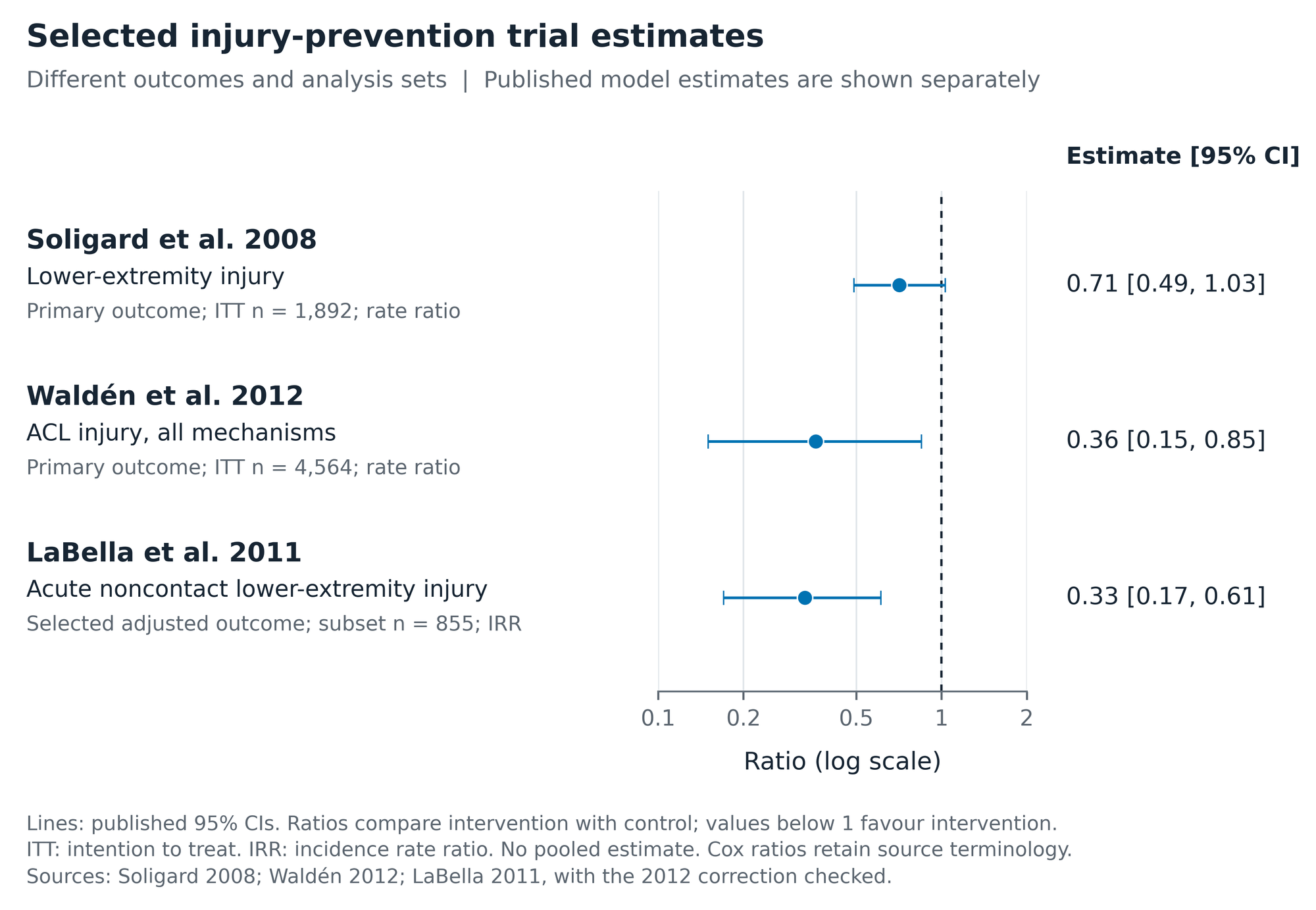
Controlled trials support programmes that combine several neuromuscular training elements. Soligard and colleagues studied 1,892 adolescent female footballers. The cluster-adjusted primary lower-extremity outcome had a rate ratio of 0.71 with a 95% confidence interval of 0.49 to 1.03; several secondary outcomes favoured intervention [26]. The primary result should remain visible when the trial is cited. It supports neither a claim that every injury category was reduced nor identification of the effective biomechanical component.
In the Waldén trial, 4,564 adolescent female footballers completed follow-up. ACL injury occurred in 7 intervention and 14 control players, with a reported rate ratio of 0.36 (95% confidence interval 0.15 to 0.85) [27]. This primary outcome included ACL injuries generally. The exploratory noncontact-only intention-to-treat result was less precise and did not exclude no difference. The distinction matters when translating a prevention trial into claims about a specific injury mechanism.
LaBella and colleagues also evaluated a coach-led warm-up in female soccer and basketball athletes in urban public high schools; 1,492 athletes completed the study [28]. The trial extends the implementation context beyond elite programmes and supports prevention in settings with different resources. Its covariate-adjusted regression analyses were restricted to a participant subset with available personal information. Table 3 preserves differences among the trials rather than reducing them to one universal percentage reduction.
Selected prevention trials report different outcomes and analysis sets, which should remain explicit when their effect estimates are displayed together (Figure 3).
| Trial | Setting and sample | Result relevant to interpretation |
|---|---|---|
| Soligard et al [26] | Adolescent female football and 1,892 players | Primary lower-extremity rate ratio 0.71, 95% CI 0.49–1.03; secondary benefits do not make the primary estimate conclusive |
| Waldén et al [27] | Adolescent female football and 4,564 players | Primary ACL rate ratio 0.36, 95% CI 0.15–0.85; 7 versus 14 events; not a noncontact-only effect estimate |
| LaBella et al [28] | Urban public-school female soccer and basketball and 1,492 completers | Supports coach-led prevention in a different setting; adjusted analyses used a subset with covariate data |
These programmes do not require a validated personal-risk label before an athlete can benefit from participation. Screening may still identify a current deficit or guide individualised progression, but a speculative risk threshold should not become a prerequisite for access to established prevention. The decision to provide a programme and the decision to pursue additional assessment are distinct.
Intervention efficacy also does not establish its mechanism. A programme may change strength, movement strategy, preparation or confidence through several pathways. Observing improved landing mechanics alongside fewer injuries does not prove that the mechanical change caused the benefit. Randomisation of the programme does not randomise the mediator. A causal mediation study would need repeated measurements before injury, adequate event information, an explicit causal model and attention to factors affecting both adaptation and outcome. Until then, changes in joint mechanics are candidate explanations or accompanying adaptations.
Programme total effects and proposed biomechanical mediation pathways require different evidence (Figure 4).
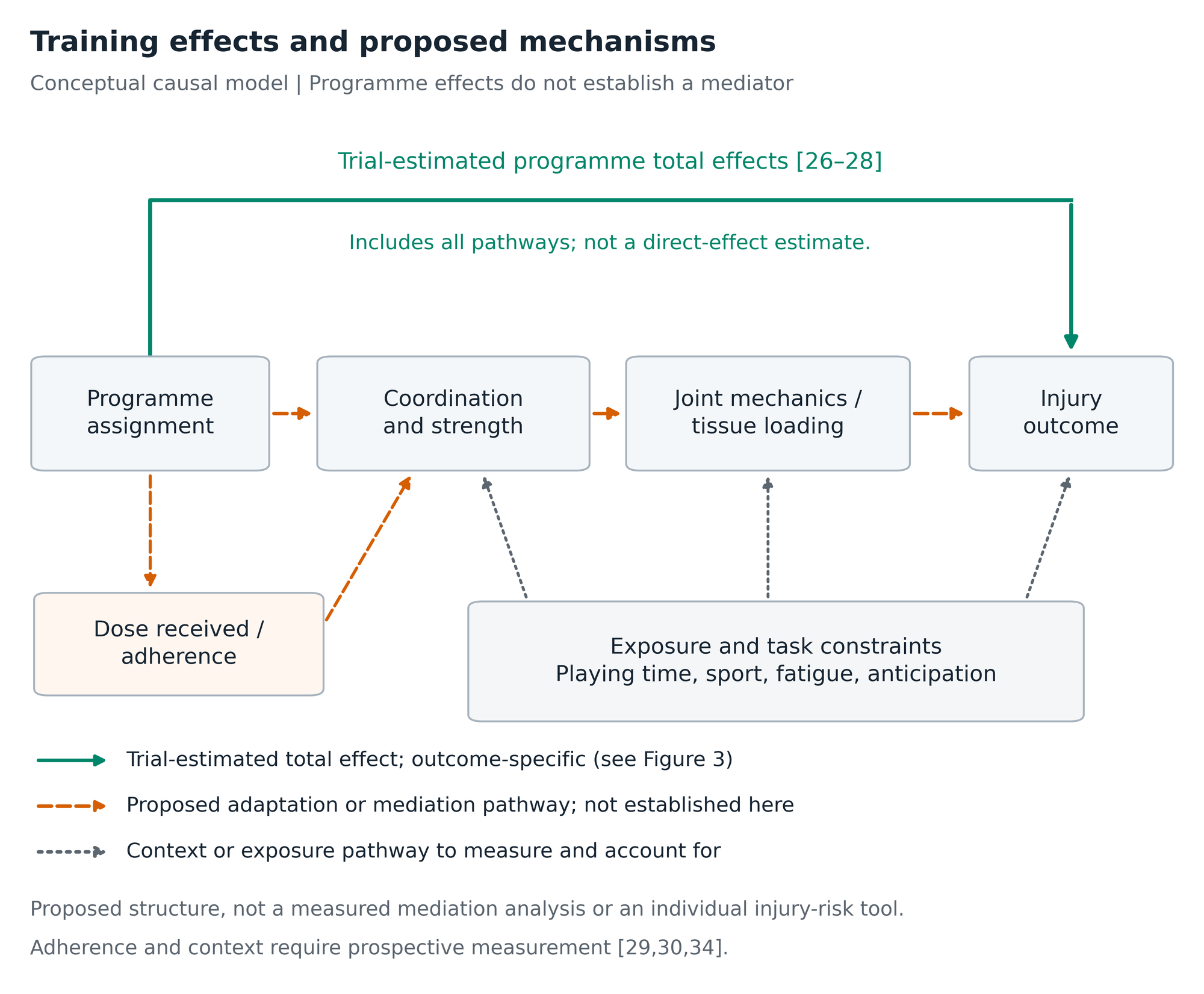
Delivery is part of the intervention. Soligard and colleagues’ subsequent compliance study found associations between participation, coach attitudes and injury outcomes [29]. Because adherence was not randomly assigned, these associations do not prove a simple dose-response mechanism. They do support measuring what athletes actually receive. Finch’s Translating Research into Injury Prevention Practice framework makes implementation context an explicit stage of prevention research [30]. Staff time, progression, player attendance and competing training demands should therefore be reported alongside the exercise content.
Measurement quality before longitudinal interpretationCalidad de la medición antes de la interpretación longitudinalجودة القياس قبل التفسير الطوليअनुदैर्ध्य व्याख्या से पहले माप-गुणवत्ता
Reliability is variable-specific and context-specific. A high intraclass correlation can coexist with substantial absolute error when participants vary widely. Reporting the intraclass-correlation model, confidence interval and an absolute error estimate is more informative than assigning a general reliability label to a test [31]. In 41 elite female handball and football athletes, Mok and colleagues found that repeatability differed across knee variables and between within-session and between-session comparisons [32]. These results cannot be assumed to describe another operator, device, task or processing pipeline.
Where independent repeated measurements have approximately normal errors of equal variance and no unaccounted systematic shift, a conventional individual smallest detectable change is
Here, SEM is the standard error of measurement for the relevant protocol [31]. The formula is inappropriate without checking its assumptions, and a detectable change is not necessarily a meaningful clinical improvement. A protocol can detect a small change that has no established relationship to function, symptoms or injury. Conversely, a group effect can be estimated precisely while individual change remains uncertain.
Processing decisions can materially change kinetics. Kristianslund and colleagues demonstrated that different filtering choices for force and motion data can create inverse-dynamics artifacts and alter inferred joint moments [33]. Sampling rate, filter type and order, cutoff frequency, synchronization and derivative calculation must therefore be reported. A single cutoff should not be adopted as universally correct. Its adequacy depends on the task and outcome, and sensitivity analysis should examine whether reasonable alternatives change the principal conclusion.
Other necessary details include calibration, segment definitions, anatomical landmark placement, foot model, event thresholds, successful-trial criteria and treatment of missing trajectories. Report how many trials were attempted, rejected and analysed, with reasons. Retaining only successful contacts may preferentially remove the very difficulty that matters clinically. Failed measurement and failed task performance should be recorded separately. Temporal normalisation supports waveform comparison but can conceal differences in actual event duration; clinically relevant peaks and intervals should remain interpretable in time.
Normalisation also requires a rationale. Dividing moments by body mass facilitates some comparisons but does not remove every influence of stature, limb length or speed. Absolute and normalised values should be available when feasible, and dimensionless scaling should be defined rather than described loosely as adjustment for size. Repeated-session comparisons should use the same definitions and monitor calibration or software changes. A change in the processing pipeline must not be mistaken for biological adaptation.
A practical framework for research and rehabilitationUn marco práctico para la investigación y la rehabilitaciónإطار عملي للبحث والتأهيلशोध और पुनर्वास के लिए एक व्यावहारिक ढाँचा
The proposed framework begins with a decision and proceeds through the evidence required to justify it. It is a synthesis of the reviewed literature and mechanical reasoning, not a validated clinical score. Table 4 provides four distinct uses of landing assessment, each with a different evidential endpoint.
| Intended use | Essential evidence | Decision boundary |
|---|---|---|
| Describe a task strategy | Valid definitions, task achievement and measurement uncertainty | Description does not establish pathology |
| Monitor adaptation | Repeated-session error, stable protocol and absolute change | Detectable change is not automatically beneficial |
| Estimate a future outcome | Adequate events, calibration and external validation | Association or internal accuracy is insufficient |
| Improve prevention or rehabilitation | Comparative outcome evidence, feasibility and delivery assessment | Changing a surrogate does not prove outcome benefit |
10.1Design linked but distinct research streamsDiseñar líneas de investigación vinculadas pero diferenciadasتصميم مسارات بحثية مترابطة لكنها متمايزةजुड़ी हुई किंतु पृथक शोध-धाराएँ रचें
A multicentre programme could share acquisition manuals and processing code while retaining separate primary questions. A measurement stream would establish repeatability and agreement across operators and sites. A longitudinal stream would test prespecified mechanical features against clearly defined outcomes. A pragmatic intervention stream would determine whether a feasible programme changes injury burden or useful rehabilitation outcomes. Combining the streams becomes valuable when a reliably measured adaptation precedes an outcome and the intervention can be delivered as intended; collecting them together does not itself prove the causal link.
Prospective surveillance should distinguish index, recurrent and subsequent injuries, report case definitions and ascertainment, and record individual exposure. The IOC surveillance consensus recommends separate reporting of training and competition exposure and explains why the denominator must match the question [34]. Injury counts per season, injuries per exposure hour and time-loss burden are different outcomes. An athlete who returns to greater participation may face more opportunities for injury even while functional capacity improves. Exposure can therefore be part of the pathway under study, not simply a nuisance covariate.
The effective information size for prognosis depends heavily on injury events and independent athletes, not the number of recorded landings. Hundreds of trials from a few athletes do not support a complex injury model. Analyses should account for repeated observations and team clustering, prespecify important comparisons and distinguish exploratory findings from confirmation. Missing follow-up, withdrawal from sport and selective availability of high-quality motion data also require an explicit analysis strategy. Sharing deidentified derived data where permitted, processing code and a data dictionary would make independent replication more feasible.
For a smaller research group, a focused measurement or feasibility study may resolve more uncertainty than an underpowered prediction model. Useful questions include whether a variable remains stable across operators, whether a task exposes a persistent unilateral deficit at comparable performance, and whether a practical intervention produces retained rather than immediately coached change. These questions are scientifically useful without attaching an unverified injury probability to every measurement.
10.2Use landing analysis within a broader rehabilitation decisionUtilizar el análisis del aterrizaje dentro de una decisión rehabilitadora más ampliaاستخدام تحليل الهبوط ضمن قرار تأهيلي أوسعलैंडिंग-विश्लेषण का उपयोग व्यापक पुनर्वास-निर्णय के भीतर करें
After ACL injury, whole limb assessment can identify a strategy that deserves further examination, such as reduced reconstructed-knee work at a comparable task demand. The result should be integrated with strength, symptoms, swelling, task tolerance, psychological readiness and the demands of the intended sport. The Panther consensus describes return to sport as a progression that incorporates clinical, biological and contextual considerations [35]. A landing test contributes information within that progression; it does not establish readiness for every competitive situation.
Feedback should have a defined aim, an observable outcome and a plan to reassess retention. Immediate changes under instruction may disappear when attention shifts to the game. Assessment should therefore include uncoached performance when appropriate and examine whether an apparent improvement was obtained by sacrificing the task goal. The purpose is to expand the athlete’s available movement solutions and capacity, rather than force every athlete toward one template.
Communication should preserve the useful observation. A clinician might explain that a knee contributes less work in the tested task, that the difference exceeds the protocol’s expected error, and that strength or task progression warrants further assessment. That is more defensible than converting the result into a personal rupture probability. Similarly, an improvement in symmetry should be described alongside the absolute performances of both limbs. The athlete should understand what the assessment establishes, what remains uncertain and how the result will inform the next rehabilitation decision.
Limitations and prioritiesLimitaciones y prioridadesالقيود والأولوياتसीमाएँ और प्राथमिकताएँ
Purposive selection, English-language search terms and unequal full-text access may have omitted relevant evidence. The review does not quantify the total body of evidence or provide formal certainty ratings. Laboratory tasks, joint definitions and populations differ substantially; some methodological and mechanistic sources concern men, mixed samples, walking or controlled tissue loading. Their inclusion supports bounded reasoning rather than direct estimates for all female athletes. The recent directional drop-jump study was appraised from its abstract, restricting detailed evaluation of its support-moment calculation and analysis choices.
Priority studies should replicate whole limb findings in diverse female populations, compare absolute and relative outcomes at clearly described task demands, and establish whether repeatable changes transfer to meaningful function. Prognostic work needs adequate event information and external validation. Prevention studies should preserve robust programme evaluation while testing plausible mechanisms and delivery processes. No study design should be asked to answer all these questions through a single surrogate measure.
ConclusionConclusiónالخلاصةनिष्कर्ष
Whole limb landing analysis can reveal mechanical strategies that performance scores and isolated knee measures miss. Its translational value depends on precise definitions, representative tasks and explicit uncertainty. External forces, net joint demands and internal tissue loads must remain distinct, as must mechanism, prognosis and intervention benefit. The strongest route to useful prevention and rehabilitation combines reproducible measurement, appropriately designed outcome studies and feasible programme delivery. Current evidence supports informed assessment and neuromuscular prevention without a universal safe landing profile, personal injury cutoff or stand-alone clearance test.
Author InformationInformación de los autoresمعلومات المؤلفينलेखक-जानकारी
DeclarationsDeclaracionesالإقراراتघोषणाएँ
No specific funding was received for this work.
The authors declare no competing interests.
This review synthesises published literature. It reports no new participant recruitment, identifiable participant material or individual-level experimental data collection; ethical approval was therefore not required.
No new experimental dataset was generated. Sources are identified in the reference list. Source-verification and search records are held by the JMMBS editorial office and are available on reasonable request.
AI-assisted tools supported literature discovery, language editing, reference checking and document preparation. No participant data or experimental results were generated. The authors reviewed and verified the content and take full responsibility for the published article.
Juan Francisco Garcia Vazquez, PhD — via the JMMBS editorial office, info@jmmbs.org.
ReferencesReferenciasالمراجعसंदर्भ
- Crossley KM, Whittaker JL, Patterson B, Shill IJ, Heming EE, Bullock GS, et al. Female, woman and/or girl Athlete Injury pRevention (FAIR) practical recommendations: International Olympic Committee (IOC) consensus meeting held in Lausanne, Switzerland, 2025. Br J Sports Med. 2025;59(22):1546-1559. https://doi.org/10.1136/bjsports-2025-110889
- Lin HB, Cannon J. Invariant multi-joint control strategies are observed during vertical and lateral drop jumps in female athletes despite differences in absolute limb- and joint-level mechanical demands. J Biomech. 2026;207:113558. https://doi.org/10.1016/j.jbiomech.2026.113558
- Hicks JL, Uchida TK, Seth A, Rajagopal A, Delp SL. Is my model good enough? Best practices for verification and validation of musculoskeletal models and simulations of movement. J Biomech Eng. 2015;137(2):020905. https://doi.org/10.1115/1.4029304
- Wu G, Siegler S, Allard P, Kirtley C, Leardini A, Rosenbaum D, et al. ISB recommendation on definitions of joint coordinate system of various joints for the reporting of human joint motion—part I: ankle, hip, and spine. J Biomech. 2002;35(4):543–548. https://doi.org/10.1016/S0021-9290(01)00222-6
- Zelik KE, Honert EC. Ankle and foot power in gait analysis: implications for science, technology and clinical assessment. J Biomech. 2018;75:1–12. https://doi.org/10.1016/j.jbiomech.2018.04.017
- Kotsifaki A, Whiteley R, Van Rossom S, Korakakis V, Bahr R, Sideris V, et al. Single leg hop for distance symmetry masks lower limb biomechanics: time to discuss hop distance as decision criterion for return to sport after ACL reconstruction? Br J Sports Med. 2022;56(5):249-256. https://doi.org/10.1136/bjsports-2020-103677
- Mulligan CMS, Gibbs ER, Huang YL, Stutzenberger LR, Johnson ST, Norcross MF. Single-legged triple-hop propulsion strategies in females with and those without a history of anterior cruciate ligament reconstruction. J Athl Train. 2023;58(4):319–328. https://doi.org/10.4085/1062-6050-0676.21
- Wellsandt E, Failla MJ, Snyder-Mackler L. Limb Symmetry Indexes Can Overestimate Knee Function After Anterior Cruciate Ligament Injury. J Orthop Sports Phys Ther. 2017;47(5):334-338. https://doi.org/10.2519/jospt.2017.7285
- Blackburn JT, Padua DA. Influence of trunk flexion on hip and knee joint kinematics during a controlled drop landing. Clin Biomech (Bristol). 2008;23(3):313-319. https://doi.org/10.1016/j.clinbiomech.2007.10.003
- Beynnon BD, Fleming BC, Johnson RJ, Nichols CE, Renström PA, Pope MH. Anterior cruciate ligament strain behavior during rehabilitation exercises in vivo. Am J Sports Med. 1995;23(1):24-34. https://doi.org/10.1177/036354659502300105
- Li G, Rudy TW, Sakane M, Kanamori A, Ma CB, Woo SL. The importance of quadriceps and hamstring muscle loading on knee kinematics and in-situ forces in the ACL. J Biomech. 1999;32(4):395-400. https://doi.org/10.1016/s0021-9290(98)00181-x
- Koga H, Nakamae A, Shima Y, Iwasa J, Myklebust G, Engebretsen L, et al. Mechanisms for noncontact anterior cruciate ligament injuries: knee joint kinematics in 10 injury situations from female team handball and basketball. Am J Sports Med. 2010;38(11):2218-2225. https://doi.org/10.1177/0363546510373570
- Hewett TE, Myer GD, Ford KR, Heidt RS Jr, Colosimo AJ, McLean SG, et al. Biomechanical measures of neuromuscular control and valgus loading of the knee predict anterior cruciate ligament injury risk in female athletes: a prospective study. Am J Sports Med. 2005;33(4):492-501. https://doi.org/10.1177/0363546504269591
- Krosshaug T, Steffen K, Kristianslund E, Nilstad A, Mok KM, Myklebust G, et al. The Vertical Drop Jump Is a Poor Screening Test for ACL Injuries in Female Elite Soccer and Handball Players: A Prospective Cohort Study of 710 Athletes. Am J Sports Med. 2016;44(4):874-883. https://doi.org/10.1177/0363546515625048
- Corrigendum. Am J Sports Med. 2017;45(9):NP28-NP29. https://doi.org/10.1177/0363546517716155
- Bahr R. Why screening tests to predict injury do not work-and probably never will…: a critical review. Br J Sports Med. 2016;50(13):776-780. https://doi.org/10.1136/bjsports-2016-096256
- Paterno MV, Schmitt LC, Ford KR, Rauh MJ, Myer GD, Huang B, et al. Biomechanical measures during landing and postural stability predict second anterior cruciate ligament injury after anterior cruciate ligament reconstruction and return to sport. Am J Sports Med. 2010;38(10):1968-1978. https://doi.org/10.1177/0363546510376053
- Aoki A, Koresawa K, No Y, Sadakiyo M, Kubota S, Lee SP, et al. Novel measures of frontal plane knee wobbling predict anterior cruciate ligament injury in Japanese female basketball players: a prospective pilot study. Clin Biomech (Bristol). 2026;133:106768. https://doi.org/10.1016/j.clinbiomech.2026.106768
- Straub RK, Powers CM. Prediction of secondary ACL injury in female athletes using 2D video-based measurements obtained during dynamic tasks: a retrospective case-control study. Br J Sports Med. 2025;59(20):1418–1425. https://doi.org/10.1136/bjsports-2025-109886
- Collins GS, Moons KGM, Dhiman P, Riley RD, Beam AL, Van Calster B, et al. TRIPOD+AI statement: updated guidance for reporting clinical prediction models that use regression or machine learning methods. BMJ. 2024;385:e078378. https://doi.org/10.1136/bmj-2023-078378
- Moons KGM, Damen JAA, Kaul T, Hooft L, Andaur Navarro C, Dhiman P, et al. PROBAST+AI: an updated quality, risk of bias, and applicability assessment tool for prediction models using regression or artificial intelligence methods. BMJ. 2025;388:e082505. https://doi.org/10.1136/bmj-2024-082505
- Xu Y, Wang R, Yuan P, Yu S, Chen W, Liu J. Influence of unanticipated side-step cutting and landing on trunk and lower limb biomechanics: A systematic review and meta-analysis. J Biomech. 2025;190:112863. https://doi.org/10.1016/j.jbiomech.2025.112863
- Borotikar BS, Newcomer R, Koppes R, McLean SG. Combined effects of fatigue and decision making on female lower limb landing postures: central and peripheral contributions to ACL injury risk. Clin Biomech (Bristol). 2008;23(1):81–92. https://doi.org/10.1016/j.clinbiomech.2007.08.008
- Sigward SM, Pollard CD, Powers CM. The influence of sex and maturation on landing biomechanics: implications for anterior cruciate ligament injury. Scand J Med Sci Sports. 2012;22(4):502-509. https://doi.org/10.1111/j.1600-0838.2010.01254.x
- Elliott-Sale KJ, Minahan CL, Janse de Jonge XAK, Ackerman KE, Sipilä S, Constantini NW, et al. Methodological considerations for studies in sport and exercise science with women as participants: a working guide for standards of practice for research on women. Sports Med. 2021;51(5):843–861. https://doi.org/10.1007/s40279-021-01435-8
- Soligard T, Myklebust G, Steffen K, Holme I, Silvers H, Bizzini M, et al. Comprehensive warm-up programme to prevent injuries in young female footballers: cluster randomised controlled trial. BMJ. 2008;337:a2469. https://doi.org/10.1136/bmj.a2469
- Waldén M, Atroshi I, Magnusson H, Wagner P, Hägglund M. Prevention of acute knee injuries in adolescent female football players: cluster randomised controlled trial. BMJ. 2012;344:e3042. https://doi.org/10.1136/bmj.e3042
- LaBella CR, Huxford MR, Grissom J, Kim KY, Peng J, Christoffel KK. Effect of neuromuscular warm-up on injuries in female soccer and basketball athletes in urban public high schools: cluster randomized controlled trial. Arch Pediatr Adolesc Med. 2011;165(11):1033–1040. https://doi.org/10.1001/archpediatrics.2011.168
- Soligard T, Nilstad A, Steffen K, Myklebust G, Holme I, Dvorak J, et al. Compliance with a comprehensive warm-up programme to prevent injuries in youth football. Br J Sports Med. 2010;44(11):787–793. https://doi.org/10.1136/bjsm.2009.070672
- Finch C. A new framework for research leading to sports injury prevention. J Sci Med Sport. 2006;9(1-2):3-9; discussion 10. https://doi.org/10.1016/j.jsams.2006.02.009
- Weir JP. Quantifying test-retest reliability using the intraclass correlation coefficient and the SEM. J Strength Cond Res. 2005;19(1):231-240. https://doi.org/10.1519/15184.1
- Mok KM, Petushek E, Krosshaug T. Reliability of knee biomechanics during a vertical drop jump in elite female athletes. Gait Posture. 2016;46:173–178. https://doi.org/10.1016/j.gaitpost.2016.03.003
- Kristianslund E, Krosshaug T, van den Bogert AJ. Effect of low pass filtering on joint moments from inverse dynamics: implications for injury prevention. J Biomech. 2012;45(4):666–671. https://doi.org/10.1016/j.jbiomech.2011.12.011
- Bahr R, Clarsen B, Derman W, Dvorak J, Emery CA, Finch CF, et al. International Olympic Committee consensus statement: methods for recording and reporting of epidemiological data on injury and illness in sport 2020 (including STROBE Extension for Sport Injury and Illness Surveillance (STROBE-SIIS)). Br J Sports Med. 2020;54(7):372-389. https://doi.org/10.1136/bjsports-2019-101969
- Meredith SJ, Rauer T, Chmielewski TL, Fink C, Diermeier T, Rothrauff BB, et al. Return to Sport After Anterior Cruciate Ligament Injury: Panther Symposium ACL Injury Return to Sport Consensus Group. Orthop J Sports Med. 2020;8(6):2325967120930829. https://doi.org/10.1177/2325967120930829
- Incorrect Data in Table 3 and in Text in: Effect of Neuromuscular Warm-up on Injuries in Female Soccer and Basketball Athletes in Urban Public High Schools: Cluster Randomized Controlled Trial. Arch Pediatr Adolesc Med. 2012;166(1):73. https://doi.org/10.1001/archpediatrics.2011.1477