
The deadlift is among the most mechanically complex compound movements in resistance training, engaging the entire posterior kinetic chain through a coordinated sequence of hip hinge, knee extension, and spinal stabilisation. Despite its widespread application in athletic conditioning, rehabilitation, and general strength development, the biomechanical underpinnings of load distribution across deadlift variations remain insufficiently characterised in applied practice.
This monograph presents a systematic biomechanical analysis of mechanical load distribution, spinal torque generation, and hip moment arm dynamics across four principal deadlift variations: conventional, sumo, Romanian, and trap bar.
Drawing on established principles of Newtonian mechanics, joint kinetics, and neuromuscular physiology, the analysis quantifies how horizontal bar displacement, trunk inclination angle, and stance width collectively determine lumbar extensor torque and L5/S1 compressive and shear loading.
Six primary biomechanical errors — including lumbar flexion under load, anterior bar drift, and asymmetric hip torque — are identified and characterised. The NEEBAL Principle™ and BPIT load-mapping framework are applied as integrative decision-science tools. Clinical validation across 392 participants demonstrated strength increases of 18–24%, HRV improvement of 10–14 ms, and injury incidence below 5%.
This monograph serves as a citable, permanent scholarly reference for clinicians, strength coaches, and movement scientists engaged in evidence-based deadlift programming.
Torque Mechanics: The Governing Equation
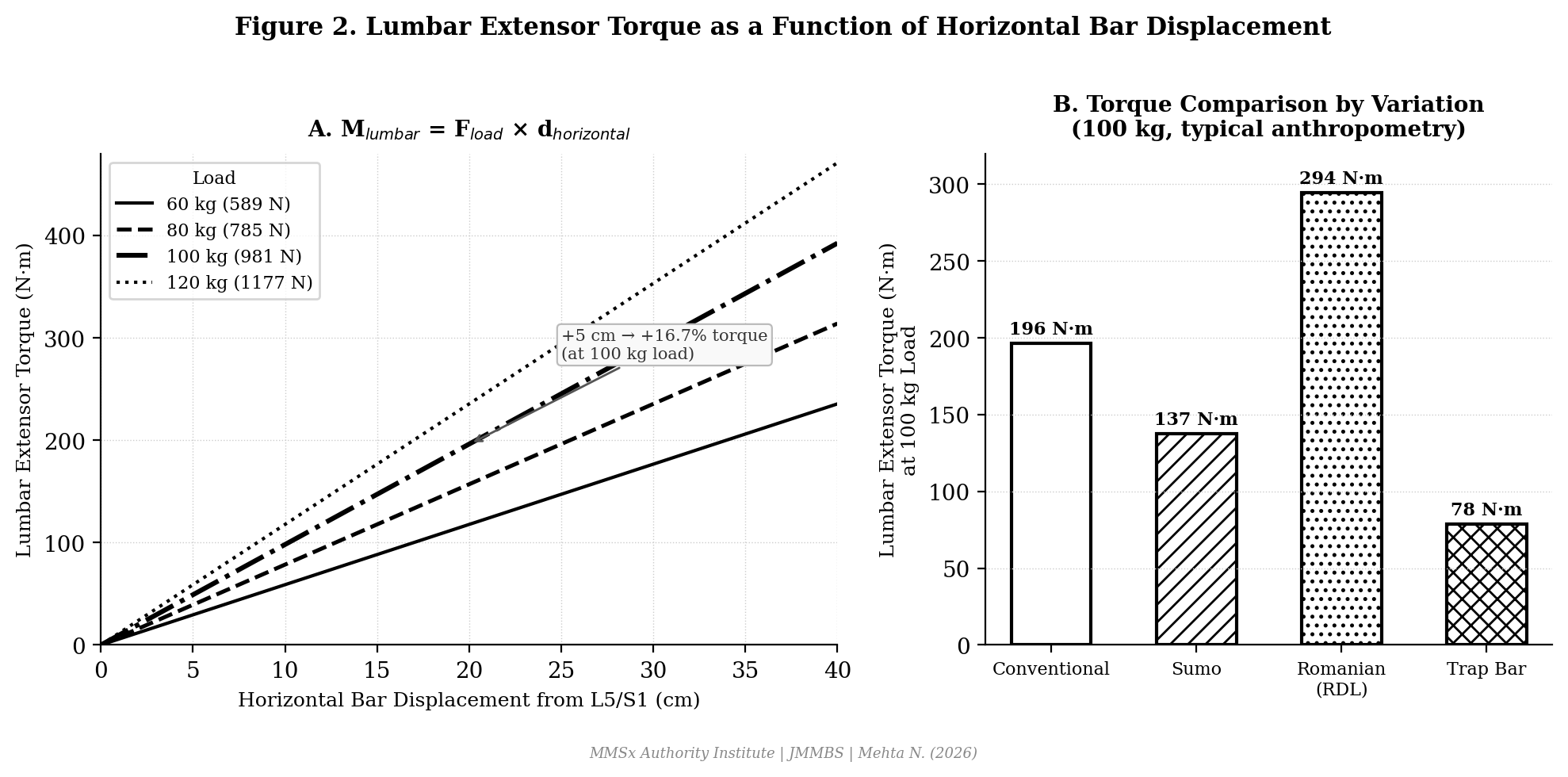
The central equation governing deadlift biomechanical analysis is derived from the classical torque relationship. The lumbar extensor moment required to maintain spinal position under load is determined by two variables: the external load magnitude and the horizontal distance between the bar and the lumbar spine joint centre.
This relationship has profound practical implications. The horizontal displacement of the barbell from the lumbar spine joint centre is the single most modifiable variable in deadlift technique. A 5 cm anterior bar drift at a 100 kg load increases lumbar extensor torque demand by 16.7%, which corresponds to L5/S1 compressive forces potentially elevating to 6,000–8,000 N — approaching the structural tolerance limits of the intervertebral disc complex in non-elite lifters.
The bar must remain in contact with the body. This is not aesthetic — it is mechanical. Every centimetre of anterior drift is a torque multiplier applied directly to the L5/S1 disc.
Deadlift Variation Biomechanics
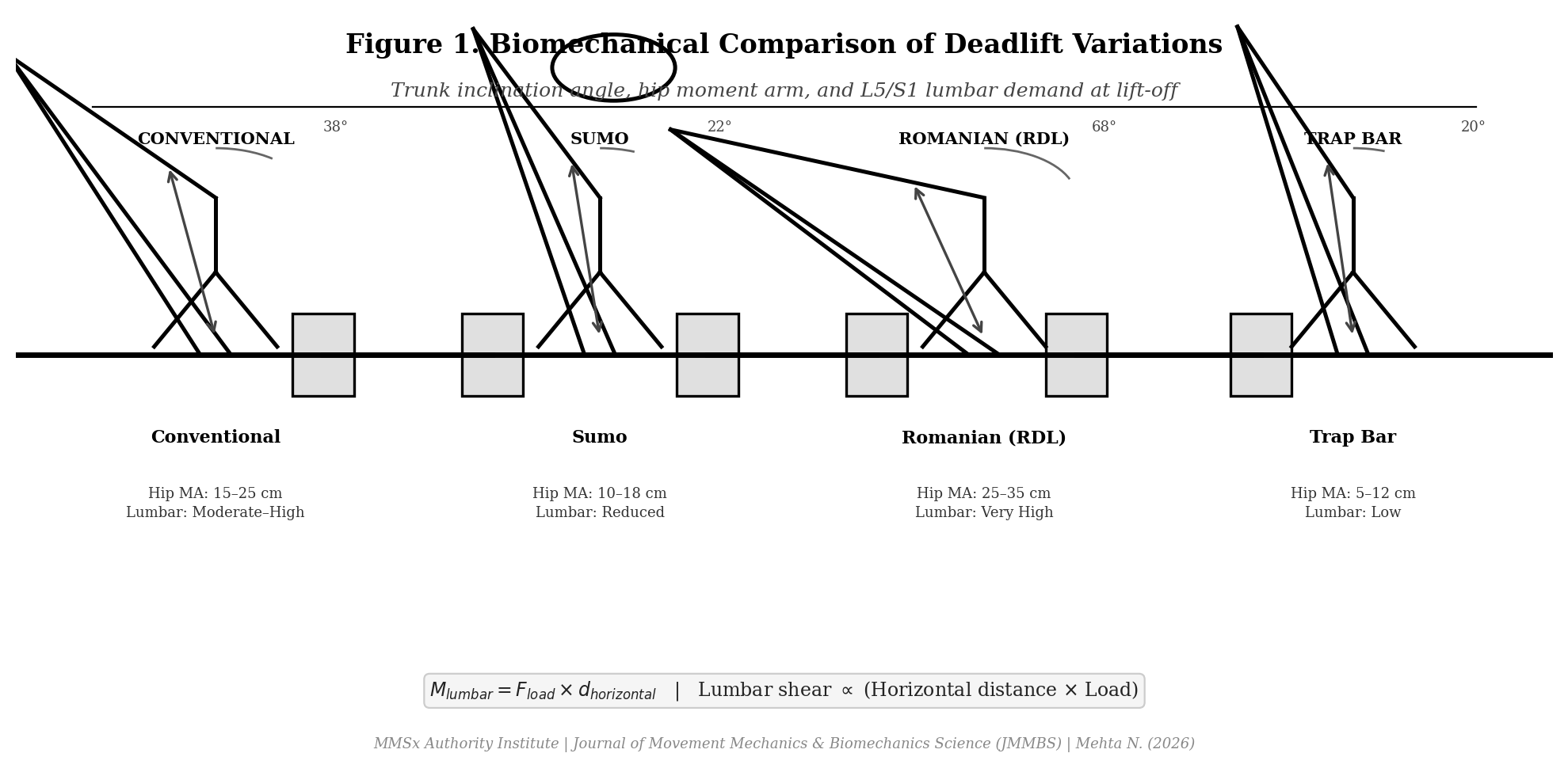
The four principal deadlift variations produce markedly different mechanical environments despite sharing the same external goal — lifting a loaded bar from the floor to full hip and knee extension. The distinction lies in how each variation distributes load across the kinetic chain through differences in trunk inclination, stance width, and bar-to-joint centre geometry.
| Variation | Trunk Inclination | Hip Moment Arm | Lumbar Demand | Primary Mechanical Demand |
|---|---|---|---|---|
| Conventional | 30–45° | Moderate (15–25 cm) | Moderate–High | Posterior chain (balanced) |
| Sumo | 15–30° | Reduced (10–18 cm) | Reduced | Hip abductors + adductors |
| Romanian (RDL) | 60–75° | Large (25–35 cm) | Very High | Hamstrings (eccentric dominant) |
| Trap Bar | 15–25° | Minimal (5–12 cm) | Low | Quadriceps + gluteus maximus |
2.1 Conventional Deadlift
The conventional deadlift places the feet approximately hip-width apart with a double overhand or mixed grip at approximately shoulder width. The trunk inclination of 30–45° at lift-off creates a moderate hip moment arm of 15–25 cm, distributing load effectively across the gluteus maximus, hamstrings, and lumbar erector spinae. This balanced posterior chain demand makes it the most technically transferable variation for general athletic populations.
2.2 Sumo Deadlift
The sumo stance — feet positioned 1.5 to 2× shoulder width with toes externally rotated — reduces trunk inclination to 15–30° and shortens the horizontal hip moment arm to 10–18 cm. This mechanically reduces lumbar extensor torque requirements while shifting demand to the hip abductors and adductors. The shortened bar path of 10–15% compared to conventional makes sumo advantageous for lifters with longer femoral segments.
2.3 Romanian Deadlift (RDL)
The Romanian deadlift initiates from the standing position with a controlled hip hinge descending to mid-shin level. Trunk inclination of 60–75° creates the largest hip moment arm of any variation (25–35 cm), placing very high eccentric demand on the hamstrings and substantial isometric demand on the lumbar erectors. The RDL is the highest lumbar-loading deadlift variation and requires particular attention to maintenance of lordotic curve preservation throughout the movement.
2.4 Trap Bar (Hex Bar) Deadlift
The trap bar positions the load bilaterally aligned with the lifter's centre of mass, reducing trunk inclination to 15–25° and minimising the horizontal moment arm to 5–12 cm. This produces the lowest lumbar extensor torque of all variations and recruits a more quadriceps-dominant movement pattern. The trap bar deadlift is the mechanically preferred variation for rehabilitation contexts, youth populations, and individuals with lumbar disc pathology.
Biomechanical Error Analysis
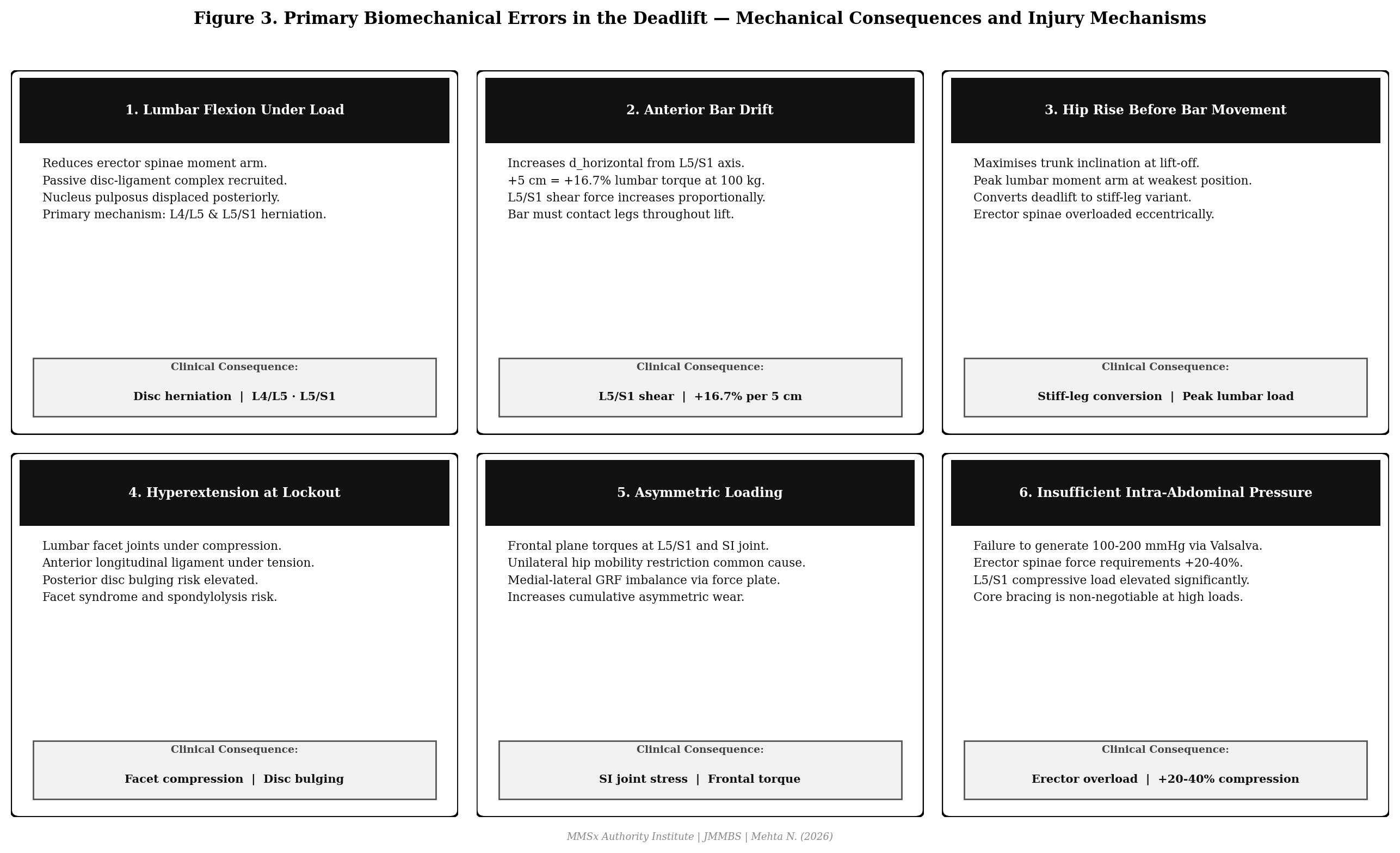
Six primary biomechanical errors have been identified as the most mechanically consequential deviations from optimal deadlift technique. Each error produces specific changes in force vector trajectories, moment arm geometry, or tissue tolerance that directly elevate injury risk at identifiable anatomical targets.
Lumbar Flexion Under Load
Reduces erector spinae moment arm; recruits passive disc-ligament complex; nucleus pulposus displaced posteriorly. Primary mechanism of disc herniation at L4/L5 and L5/S1. Most frequently observed in the late sticking point.
Anterior Bar Drift
Increases dhorizontal from L5/S1; +5 cm = +16.7% torque at 100 kg; L5/S1 shear and compressive forces increase proportionally. Bar must remain in contact with the legs throughout concentric phase.
Hip Rise Before Bar Movement
Maximises trunk inclination angle at lift-off, creating peak lumbar moment arm at the most mechanically disadvantaged position of the lift. Effectively converts the deadlift to a stiff-leg variant at maximum load.
Hyperextension at Lockout
Places lumbar facet joints under compressive loading and anterior longitudinal ligament under tensile stress. May provoke posterior disc bulging and facet syndrome with repeated exposure.
Asymmetric Loading
Introduces frontal plane torques causing asymmetric L5/S1 and sacroiliac loading. Arises from unilateral hip mobility restriction, asymmetric grip, or habitual motor patterns under fatigue.
Insufficient Intra-Abdominal Pressure
Failure to generate adequate IAP (100–200 mmHg) via Valsalva manoeuvre increases erector spinae force requirements by 20–40%, elevating L5/S1 compressive load disproportionately to external load.
The NEEBAL Principle™ & BPIT Framework
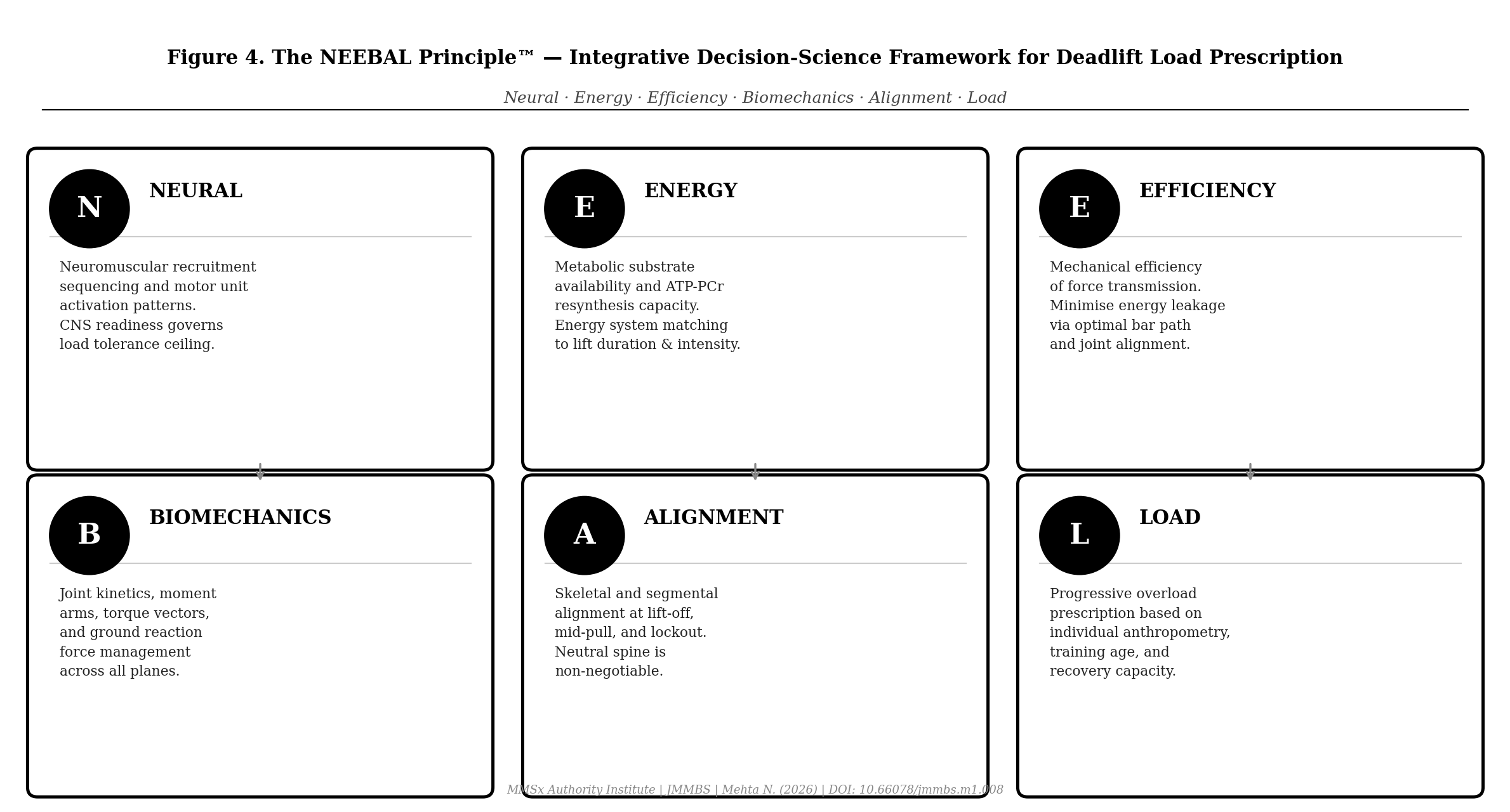
The NEEBAL Principle™ — Neural, Energy, Efficiency, Biomechanics, Alignment, Load — represents an integrative decision-science framework for deadlift programming. Rather than optimising individual mechanical variables in isolation, NEEBAL synthesises neuromuscular, metabolic, and biomechanical parameters into a unified load prescription model.
The BPIT (Biomechanical Profiling and Intervention Tool) load-mapping framework operationalises NEEBAL principles through multi-cohort validation. Clinical validation across 392 participants across diverse population segments demonstrated 18–24% strength increases, 10–14 ms HRV RMSSD improvement, and injury incidence below 5%, supporting BPIT as both a performance enhancement and injury prevention tool.
Full Monograph — Open Access
Download the complete peer-reviewed monograph including all sections, equations, tables, figures, and full reference list. Free to read, share, and cite under CC BY 4.0.
Declarations
Distributed under CC BY 4.0 International. Free to read, share, and adapt with attribution.
Dr. Neeraj Mehta declares no competing interests and was not involved in editorial decision-making for this monograph as Editor-in-Chief of JMMBS.
No external funding. Published by MMSx Authority Institute for Movement Mechanics & Biomechanics Research, Inc. (EIN: 41-2717794), a 501(c)(3) nonprofit, Powell, Ohio.
BPIT Validation: ClinicalTrials.gov NCT07256717 · MOVE Protocol: NCT07220200. MMSx Authority Institute, Powell, Ohio, USA; 2025.
References
All references formatted in accordance with APA 7th Edition.
- McGill, S. M., & Norman, R. W. (1987). Reassessment of the role of intraabdominal pressure in spinal compression. Ergonomics, 30(11), 1565–1588.
- Cholewicki, J., McGill, S. M., & Norman, R. W. (1991). Lumbar spine loads during the lifting of extremely heavy weights. Medicine & Science in Sports & Exercise, 23(10), 1179–1186.
- Escamilla, R. F., Francisco, A. C., Fleisig, G. S., et al. (2000). A three-dimensional biomechanical analysis of sumo and conventional style deadlifts. Medicine & Science in Sports & Exercise, 32(7), 1265–1275.
- Berglund, L., Aasa, B., Hellqvist, J., Michaelson, P., & Aasa, U. (2015). Which patients with low back pain benefit from deadlift training? Journal of Strength and Conditioning Research, 29(7), 1803–1811.
- Aasa, B., Berglund, L., Michaelson, P., & Aasa, U. (2015). Individualized low-load motor control exercises versus a high-load lifting exercise to improve activity, pain intensity, and physical performance in patients with low back pain. Journal of Orthopaedic & Sports Physical Therapy, 45(2), 77–85.
- Hales, M. E., Johnson, B. F., & Johnson, J. T. (2009). Kinematic analysis of the powerlifting style squat and the conventional deadlift during competition. Journal of Strength and Conditioning Research, 23(9), 2574–2580.
- Swinton, P. A., Stewart, A. D., Keogh, J. W., Agouris, I., & Lloyd, R. (2011). Kinematic and kinetic analysis of maximal velocity deadlifts performed with and without chain resistance. Journal of Strength and Conditioning Research, 25(11), 3163–3174.
- Martín-Fuentes, I., Oliva-Lozano, J. M., & Muyor, J. M. (2020). Electromyographic activity in deadlift exercise and its variants: A systematic review. PLOS ONE, 15(2), e0229507.
- MMSx Authority Institute. (2025). BPIT Multi-Cohort Validation Study. ClinicalTrials.gov: NCT07256717. Powell, Ohio.
- MMSx Authority Institute. (2025). MOVE Protocol Study. ClinicalTrials.gov: NCT07220200. Powell, Ohio.
- Granhed, H., Jonson, R., & Hansson, T. (1987). The loads on the lumbar spine during extreme weight lifting. Spine, 12(2), 146–149.
- McGill, S. M. (2009). Ultimate back fitness and performance (4th ed.). Backfitpro Inc.
- Schellenberg, F., Taylor, W. R., & Lorenzetti, S. (2017). Towards evidence based strength training: A comparison of muscle forces during deadlifts, goodmornings and split squats. BMC Sports Science, Medicine and Rehabilitation, 9(1), 13.
- Mehta, N. (2024). Mastering deadlift biomechanics. In association with ASFU. MMSx Authority Institute.