
- Validity belongs to a specified output, population, task, setting and decision — not to a device.
- Favourable average waveform agreement can coexist with missed individual abnormalities and gait-classification disagreement.
- Kinematic agreement does not establish kinetic validity; net joint moments are not tissue forces.
- Detectable change, clinically important change and improved decisions each require separate evidence.
- La validez corresponde a una salida, población, tarea, entorno y decisión especificados, no a un dispositivo.
- Una concordancia favorable en las curvas medias puede coexistir con anomalías individuales no detectadas y con desacuerdos en la clasificación de la marcha.
- La concordancia cinemática no establece la validez cinética; los momentos articulares netos no son fuerzas tisulares.
- El cambio detectable, el cambio clínicamente importante y la mejora de las decisiones requieren, cada uno, evidencia independiente.
- تنتمي الصلاحية إلى مُخرَج وفئة سكانية ومهمة وبيئة وقرار محدّدة، لا إلى جهاز بعينه.
- قد يتعايش التوافق الجيد في متوسط المنحنيات مع تفويت حالات شاذة فردية واختلاف في تصنيف المشي.
- لا يُثبت التوافق الكينماتيكي الصلاحيةَ الكينتيكية؛ والعزوم المفصلية الصافية ليست قوى نسيجية.
- يتطلب كلٌّ من التغير القابل للكشف والتغير المهم سريريًا وتحسين القرارات أدلةً مستقلة.
- वैधता किसी उपकरण की नहीं, बल्कि निर्दिष्ट आउटपुट, जनसंख्या, कार्य, परिवेश और निर्णय की होती है।
- औसत तरंग-रूपों में अनुकूल सहमति के साथ व्यक्तिगत असामान्यताएँ छूट सकती हैं और चाल-वर्गीकरण में असहमति हो सकती है।
- काइनेमैटिक सहमति काइनेटिक वैधता स्थापित नहीं करती; शुद्ध संधि-आघूर्ण ऊतक-बल नहीं हैं।
- पता लगाने योग्य परिवर्तन, नैदानिक रूप से महत्वपूर्ण परिवर्तन और बेहतर निर्णय — प्रत्येक के लिए अलग साक्ष्य चाहिए।
IntroductionIntroducciónالمقدمةपरिचय
Quantitative movement analysis can help explain how a person completes a task, how mechanical demands change after treatment, and whether a performance improvement conceals redistribution between joints. Conventional laboratory assessment can be difficult to repeat in community settings because it requires equipment, preparation, and specialist interpretation. Markerless motion capture addresses some of these acquisition barriers by deriving body motion from images. Its development has progressed from geometric reconstruction of body shape to contemporary pose estimation and model-based analysis [1,2]. However, easier acquisition does not itself establish the validity of a clinical interpretation.
The relevant question is whether an output is sufficiently accurate and informative for the decision being considered. A system suitable for estimating walking speed may be unsuitable for identifying a small change in axial knee rotation. An algorithm that reproduces a group-average waveform may miss an unusual pattern in the individual who most needs assessment. OpenCap demonstrates how smartphone videos can be combined with musculoskeletal simulation to estimate kinematics and dynamics [3]. The broader clinical literature nevertheless identifies unresolved questions about anatomical correspondence, pathological movement, and the transfer of validation between settings [4].
This review examines the chain from recorded images to clinical decisions. It contributes three practical elements: a distinction between the quantities being measured or estimated; an evidence map separating laboratory agreement, clinical applicability, and multicentre group differentiation; and a proposed validation pathway with explicit decision consequences. The emphasis is on lower-limb movement and gait because these tasks dominate the selected empirical examples. The principles also apply to other movements, but the empirical results cannot be generalised automatically to upper-limb tasks, wheelchair use, or all sporting actions. The proposed pathway is a methodological synthesis, not a consensus standard, validated score, or clinical clearance rule.
Evidence identification and critical appraisalIdentificación de la evidencia y evaluación críticaتحديد الأدلة والتقييم النقديसाक्ष्य की पहचान और समालोचनात्मक मूल्यांकन
Targeted web searches of scholarly records indexed in PubMed, accessible PubMed Central articles, publisher websites, and institutional repositories were updated on 10 November 2026. Search combinations addressed markerless motion capture, pose estimation, clinical gait, concurrent validity, repeatability, cerebral palsy, knee osteoarthritis, OpenCap, functional tasks, clothing, joint coordinate systems, and musculoskeletal validation. Exact-title and DOI searches checked the supplied manuscript’s references and identified relevant newer studies. Methodological searches addressed agreement with repeated observations, reliability, measurement error, and the evaluation of clinical prediction and decision-support systems.
Sources were selected for their direct contribution to a specific interpretive question. Human validation studies received priority for empirical accuracy claims; original methodological publications and professional recommendations supported measurement and reporting principles. Earlier reviews supplied historical context and helped identify limitations, but they were not used to substitute pooled conclusions for direct examination of pivotal studies. The selection included studies with clinically relevant disagreement as well as encouraging results. Pure computer-vision benchmark performance without a biomechanical interpretation was outside the main scope.
The appraisal considered the target population and task, acquisition conditions, anatomical definitions, reference-system limitations, independence of development and evaluation data, repeated-measure structure, and relevance of the reported outcome to an individual decision. Available full texts were examined for pivotal methodological details. When only an abstract or indexed record was accessible, statements were restricted to information explicitly reported there; unreported exclusions, model settings, and software versions were not inferred. The accompanying source register documents the accessed source and access level. Table 2 identifies the access boundary for representative empirical studies.
This was a purposive critical narrative review. It did not use a registered systematic-review protocol, duplicate screening, an exhaustive database search, or a formal risk-of-bias score. It therefore cannot estimate the prevalence of favourable results, rank commercial products, or provide a comprehensive certainty assessment. Observed findings, deductions from mechanics, and proposed research procedures are distinguished throughout. Numerical errors from different studies were not pooled because their tasks, joint definitions, comparators, metrics, and aggregation levels differ.
Specify the quantity before evaluating its validityEspecificar la magnitud antes de evaluar su validezتحديد الكمية قبل تقييم صلاحيتهاवैधता के मूल्यांकन से पहले मात्रा निर्दिष्ट करें
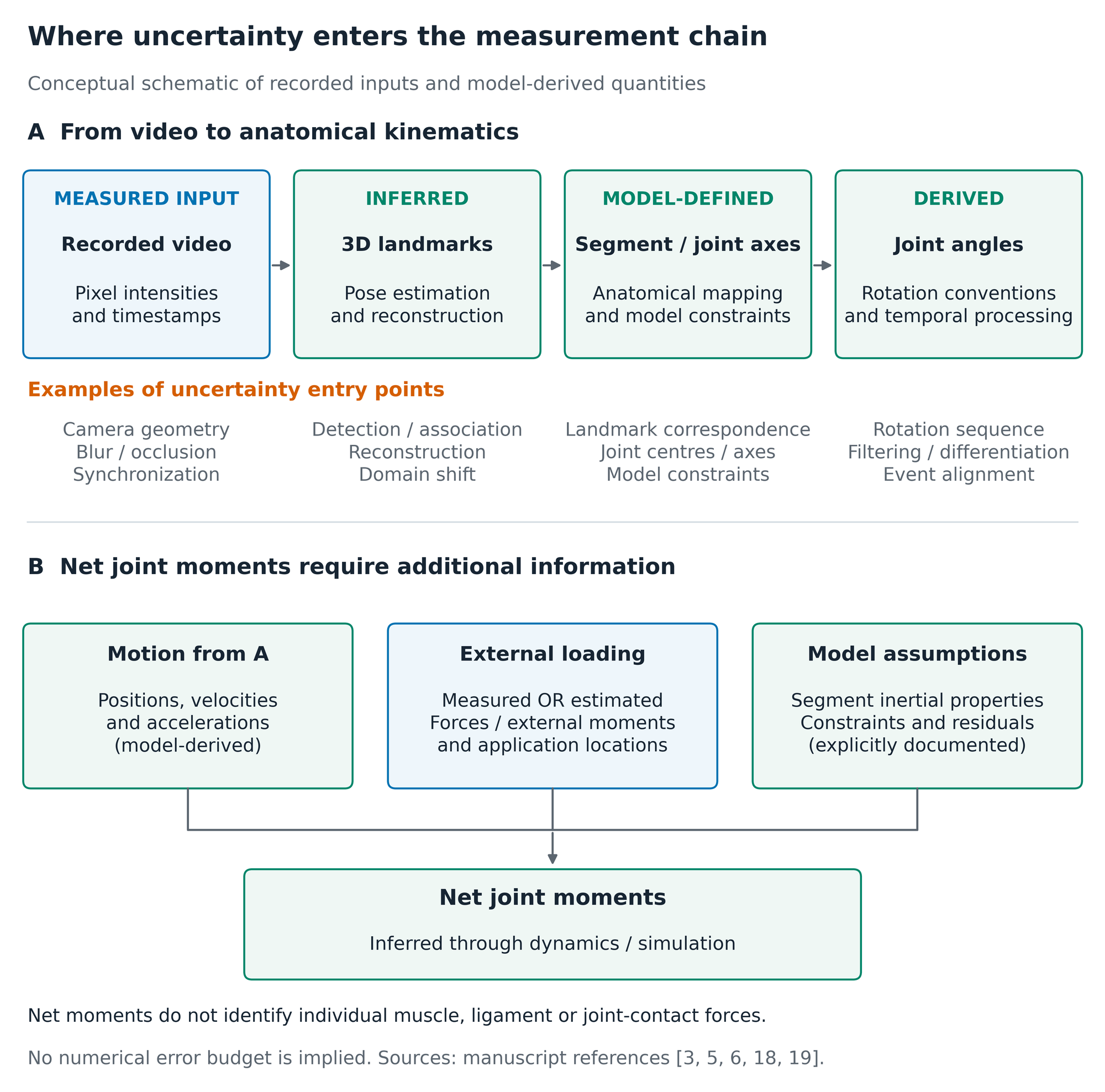
Markerless systems may produce image coordinates, reconstructed landmarks, segment orientations, joint angles, gait events, net joint moments, or estimated tissue forces. These quantities occupy different positions in the measurement chain and require different evidence. A projected two-dimensional angle is not a three-dimensional anatomical rotation. Nor is a learned image landmark necessarily equivalent to a functional joint centre or a palpated bony landmark. Joint coordinate conventions, rotation sequence, sign, and segment definition should be reported; the International Society of Biomechanics recommendations provide an established starting point for relevant joints [5].
Needham and colleagues compared several pose-estimation approaches with marker-based capture during walking, running, and jumping. Their findings showed systematic hip and knee centre differences and smaller discrepancies at some other joints [6]. The implication is that a coordinate can be repeatable while referring to a different anatomical location. An error expressed in millimetres also depends on the reference frame and any alignment performed before comparison. Removing a participant-specific offset or optimising the alignment against test data may answer a different question from evaluating an independently acquired clinical recording.
Stenum and colleagues evaluated temporal, spatial, and sagittal kinematic gait measures from two-dimensional video [7]. Their variable-specific findings illustrate why successful event timing cannot validate joint rotation or loading by extension. A pipeline may perform well at identifying foot contact while estimating the pelvis less accurately. Investigators should specify the measurement unit and aggregation rule before reporting accuracy: frame, stride, trial, session, participant mean, or individual change. A favourable mean across many degrees of freedom can conceal the error in the one variable used to select treatment.
An intended-use statement should therefore name the population, task, output, environment, operator, and decision. For example, estimating average walking speed during unassisted overground gait in adults with knee osteoarthritis is narrower and testable. Describing a device simply as clinically validated leaves these conditions unspecified. Acceptable error should be justified prospectively in relation to the consequence of misinterpretation. When no clinically anchored tolerance exists, the study should report precision and applicability without inventing a universal pass threshold. Table 1 summarises the evidence required along the measurement chain.
| Output | Required comparison or check | Boundary of interpretation |
|---|---|---|
| Image landmarks | Annotation definitions, image visibility, detection and association errors | Pixel agreement does not establish an anatomical joint centre |
| Three-dimensional landmarks | Calibration, synchronization, reconstruction, reference-frame alignment | Position agreement does not establish accurate segment orientation |
| Joint angles and gait events | Comparable anatomical models, rotation conventions, event definitions, waveform and timing errors | Validation applies to the tested joint, plane, task, and population |
| Net joint moments and powers | Motion, external forces or wrenches, model properties, synchronization, residuals | An estimated net moment is not an individual muscle or ligament force |
| Tissue-level estimates | Anatomical and physiological assumptions, independent converging validation, sensitivity analysis | Plausible model output is not direct measurement of internal loading |
| Clinical interpretation | Longitudinal or diagnostic evidence appropriate to the claim and intended decision | Measurement agreement alone does not demonstrate improved outcomes |
Figure 1 maps the measurement chain and distinguishes the additional information required to estimate net joint moments.
What empirical validation establishesLo que establece la validación empíricaما يُثبته التحقق التجريبيअनुभवजन्य सत्यापन क्या स्थापित करता है
4.1Laboratory agreement and repeatabilityConcordancia de laboratorio y repetibilidadالتوافق المخبري والتكراريةप्रयोगशाला-सहमति और पुनरावर्तनीयता
Kanko and colleagues compared synchronized markerless and marker-based gait measurements in 30 healthy adults and found agreement that varied across joint centres and rotation axes [8]. A separate study of eight adults across three sessions evaluated intersession repeatability [9]. These results address complementary questions: correspondence between systems and stability across repeated acquisition. Neither establishes responsiveness to treatment in a clinical population. Repeatability can remain high when a systematic anatomical offset is present.
Errors are not exclusively small, approximately Gaussian perturbations. In an OpenPose study involving two healthy volunteers, Nakano and colleagues observed failures including incorrect assignment of body segments [10]. Such events are qualitatively different from ordinary coordinate noise. A validation report should show both the error distribution among successful recordings and the proportion of intended recordings producing usable output. Manual repair may be legitimate, but the frequency, rules, operator effort, and agreement between operators should accompany the repaired results.
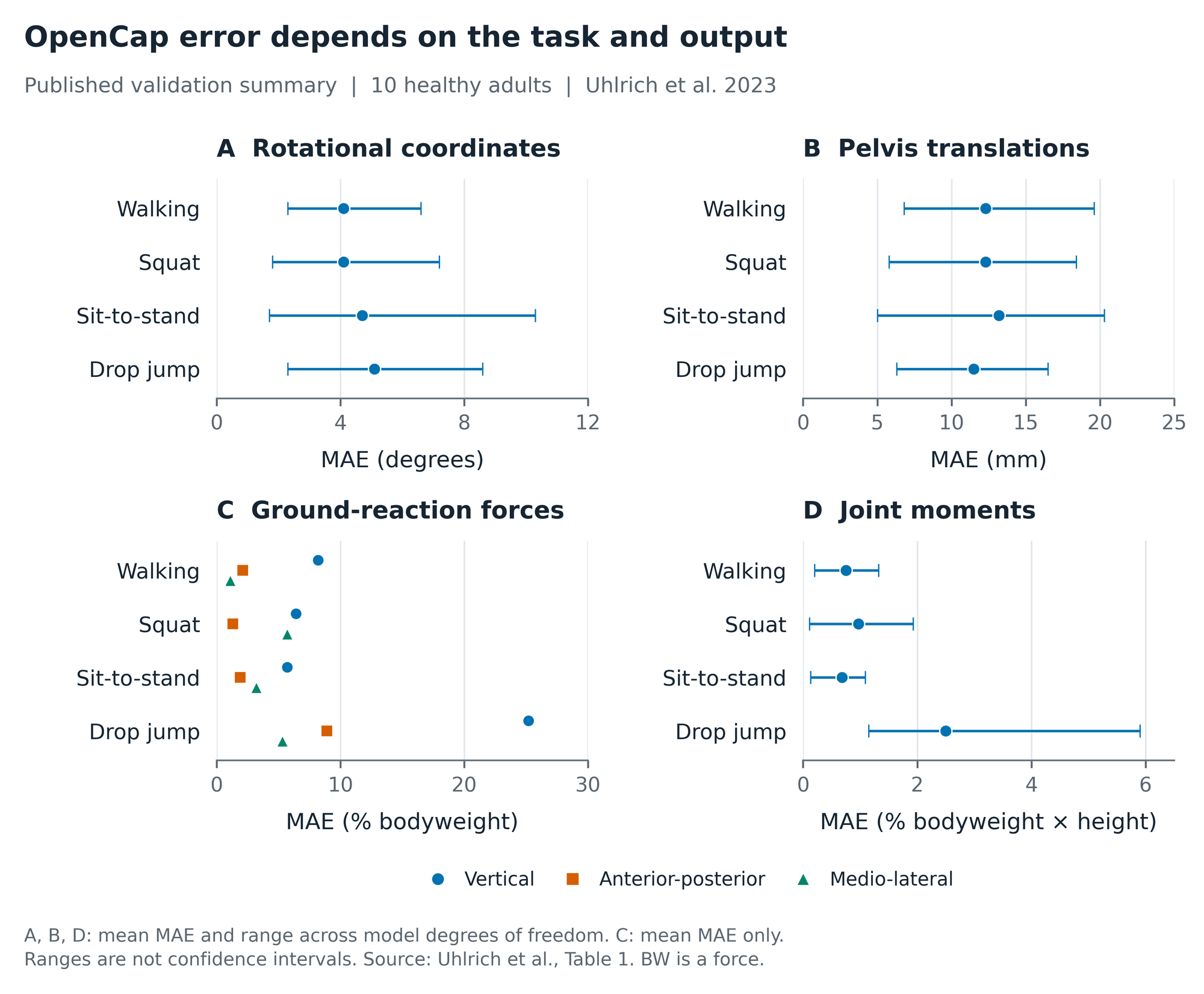
The original OpenCap evaluation included ten healthy participants performing walking, squatting, rising from a chair, and drop jumps. It reported pooled mean absolute errors of 4.5° for joint angles, 6.2% of bodyweight for ground reaction forces, and 1.2% of bodyweight multiplied by height for joint moments [3]. Those normalised quantities and aggregation choices must remain explicit. An independent evaluation by Svetek and colleagues in 20 participants found task- and joint-dependent discrepancies, including comparatively large sagittal hip errors in gait trials [11]. The studies test different protocols; their results should not be compressed into a single platform accuracy claim.
Task-specific errors from the original OpenCap validation illustrate why performance should be reported separately for each output and activity (Figure 2).
4.2Clinical populations and consequential disagreementPoblaciones clínicas y desacuerdo relevanteالفئات السريرية والاختلاف ذو الأثرनैदानिक जनसंख्याएँ और परिणामी असहमति
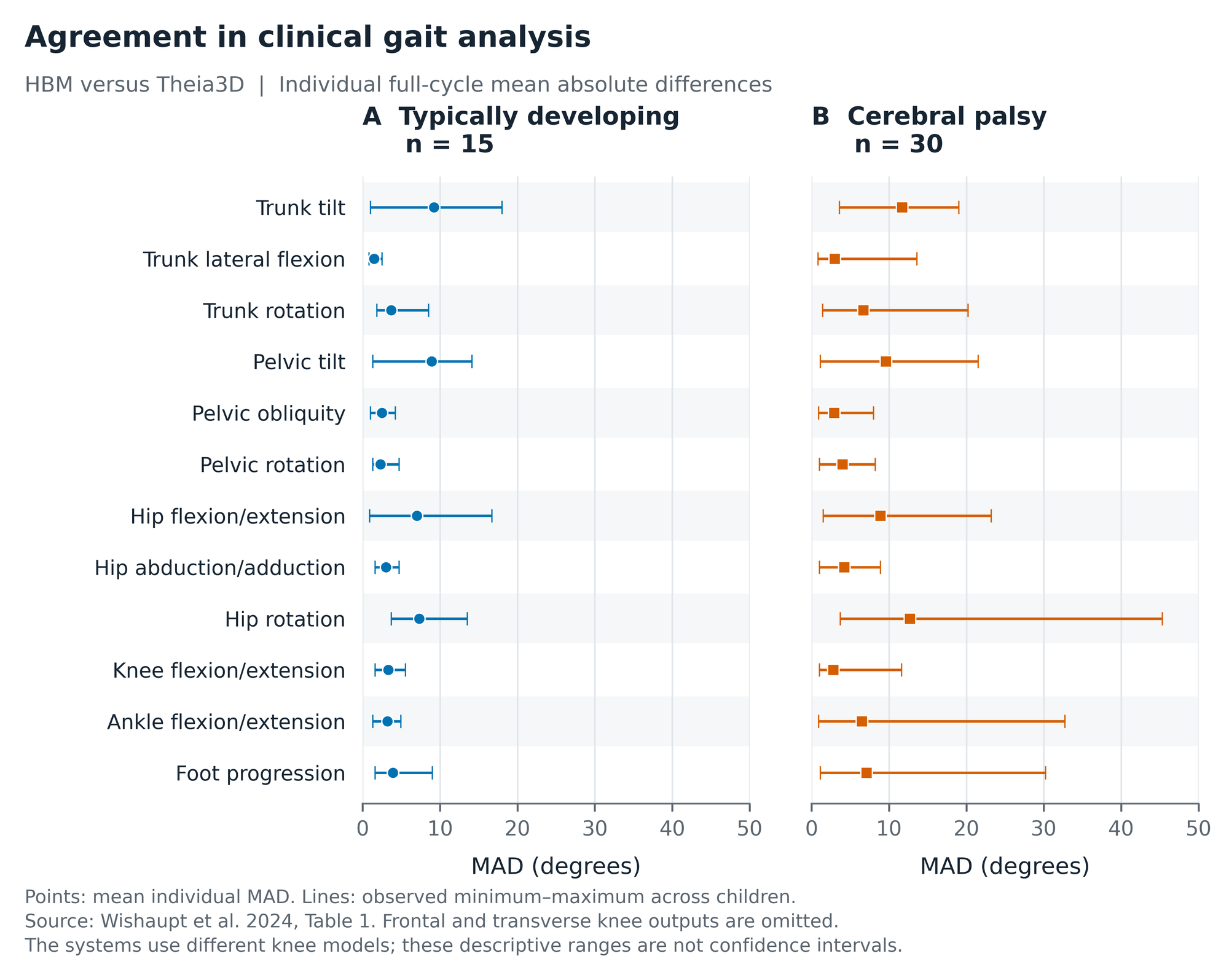
Clinical validation must examine the abnormal patterns that the intended service needs to recognise. Wishaupt and colleagues studied 30 children with spastic cerebral palsy and 15 typically developing children [12]. Although several angular patterns were reproduced, individual differences in pelvic tilt and transverse hip rotation were not captured to the same extent by the markerless system. Their full text also identifies differences between the biomechanical models, including foot segmentation and knee degrees of freedom. Thus disagreement cannot automatically be assigned entirely to image tracking.
Individual differences between marker-based and markerless gait outputs vary by anatomical variable and extend beyond the group mean (Figure 3).
A larger 2026 study by Chafetz and colleagues compared simultaneous recordings in 202 children with complex gait patterns [13]. The published abstract reports sagittal knee and ankle mean root-mean-square errors below 5°, but only 67% overall concordance for a specified sagittal gait classification, with κ = 0.60. Errors increased with body mass index and walker use. This is particularly relevant to interpretation: apparently favourable angular summaries do not guarantee equivalent classification. The result does not determine which system gave the correct classification, and it should not be extrapolated to every clinical diagnosis.
Outerleys and colleagues provide a different type of evidence. Their three-centre study included 486 participants, of whom 351 had knee osteoarthritis, and identified broadly consistent disease-associated gait differences across sites [14]. This supports the feasibility of studying group patterns in a multicentre deployment. Because group differentiation is not the same experiment as paired comparison with an independent reference, it does not establish individual interchangeability, diagnostic sensitivity, or treatment responsiveness. Appropriate recognition of this distinction strengthens the study’s contribution without overstating it.
Single-camera three-dimensional inference warrants its own evaluation. Vellucci and colleagues trained a pipeline against a 17-sensor inertial system and examined camera location, clothing, anthropometry, and gait strategy in healthy participants [15]. The best-performing viewpoint yielded reported landmark and angle root-mean-square errors of 2.97 cm and 4.24°, with gait-profile-score ICC of 0.65. These are comparisons with inertial estimates, not direct skeletal measurements. They demonstrate a development signal under tested conditions; they do not justify transferring the values to neurological or orthopaedic patients.
| Study and context | Evaluated property | Main contribution | Interpretive limit and access |
|---|---|---|---|
| Kanko et al. 2021 [8]; 30 healthy adults | Concurrent gait kinematics | Agreement varies by joint and rotation axis | Healthy treadmill gait; abstract checked |
| Kanko et al. 2021 [9]; eight healthy adults | Three-session repeatability | Demonstrates feasibility of repeated markerless gait acquisition | Small sample; repeatability is separate from accuracy; abstract checked |
| Uhlrich et al. 2023 [3]; ten healthy adults | Kinematics and dynamics across four activities | Links smartphone acquisition to model-based dynamics | Pooled errors do not validate every output or patient group; full text checked |
| Svetek et al. 2025 [11]; 20 participants | OpenCap during gait and functional tasks | Reveals important task and joint dependence | Laboratory apparatus and viewing conditions matter; full text checked |
| Wishaupt et al. 2024 [12]; cerebral palsy and comparison groups | Reproduction of clinical gait deviations | Identifies missed individual pelvic and hip variation | Anatomical model differences complicate attribution; full text checked |
| Chafetz et al. 2026 [13]; 202 children | Complex gait and classification agreement | Extends evidence to a larger clinical cohort | Published abstract only; classification agreement is not clinical outcome benefit |
| Outerleys et al. 2025 [14]; 486 participants at three centres | Group patterns and site consistency | Supports multicentre observational applications | No claim of individual criterion validity; abstract checked |
| Vellucci et al. 2026 [15]; healthy walking | Single-camera inference against an inertial system | Examines viewpoint and ecological perturbations | Reference is itself estimated; published abstract checked |
Reference methods have their own uncertaintyLos métodos de referencia tienen su propia incertidumbreللطرق المرجعية عدم يقين خاص بهاसंदर्भ-विधियों की अपनी अनिश्चितता होती है
Optical marker-based capture is an established comparison method, but skin-mounted markers do not provide direct bone motion. In a bone-pin comparison during running, Reinschmidt and colleagues demonstrated that errors from skin movement differed by rotation plane and participant [16]. Agreement with an optical system therefore means agreement with that implementation, including its marker placement, anatomical model, and processing. Inertial systems introduce different alignment, drift-correction, and modelling assumptions. Neither comparator should be described as error-free skeletal truth.
The comparison should first establish whether both pipelines target the same quantity. A multisegment foot and a single rigid foot model can produce different ankle interpretations even when both track their assigned features consistently. Similarly, a constrained knee model cannot independently express all the rotations produced by a less constrained model. Matching Cardan sequences is helpful but does not remove differences in segment axes or anatomical definitions. Model-level disagreement, tracking error, and reference error should be considered separately whenever the data permit.
A stronger study can combine synchronized comparison, independent calibration checks, repeated reference measurements, and sensitivity analyses. Where bone imaging is feasible and justified, it can answer particular anatomical questions, but its availability and field of view limit its role as a universal reference. Where direct observation of an internal quantity is unavailable, the correct response is to delimit the claim and seek converging evidence. Agreement between two algorithms sharing training data or anatomical assumptions offers less independent confirmation than agreement between genuinely independent measurement pathways.
From motion to net joint demand and internal loadingDel movimiento a la demanda articular neta y la carga internaمن الحركة إلى الطلب المفصلي الصافي والتحميل الداخليगति से शुद्ध संधि-माँग और आंतरिक भार तक
Kinematic agreement cannot be carried forward automatically to kinetic validity. For a specified rigid-body model expressed in independent generalised coordinates, a schematic balance is:
Here denotes configuration, and its time derivatives, the mass matrix, and the motion-dependent and gravitational terms. contains generalised actuation, while maps generalised motion to external contact motion and contains the corresponding external forces and moments. The exact formulation depends on the model and constraints. OpenSim provides a computational framework for constructing and solving such models [17,18]. Software availability does not establish that a particular model represents a particular patient’s anatomy or movement.
In inverse dynamics, prescribed motion and external loading determine net generalised demand under the selected assumptions. When external forces are not measured, a video-based pipeline must estimate them or introduce additional contact and physiological constraints. Unknown hand support, a carried object, or a walking aid can alter external loading without a uniquely recoverable signature in the visible joint angles. Investigators should state which forces were measured, inferred, assumed absent, or replaced by residual terms. A system’s label should not obscure these different sources of information.
Net joint moments do not identify individual muscle forces. Multiple agonist–antagonist combinations can produce the same moment, while co-contraction can change joint contact loading without a corresponding increase in the net moment. Tissue-level estimates additionally depend on muscle paths, moment arms, strength parameters, tendon behaviour, and the criterion used to resolve force sharing. Hicks and colleagues recommend verification, output-specific validation, and sensitivity analysis as linked components of credible simulation [19]. Agreement with activation timing or another indirect signal can strengthen plausibility, but it cannot convert an underdetermined internal-force estimate into a direct measurement.
The mechanical importance of geometric error can be illustrated without assigning an empirical error to a device. For a fixed force , the first-order change in moment due to a position error is . A 1,000 N force and a 0.01 m error perpendicular to its line of action produce a 10 N·m discrepancy. If force and position are both uncertain, both contributions and their dependence matter. This example is an analytical illustration, not an observed performance result or a universal error budget.
Filtering, differentiation, synchronization, and event alignment also affect kinetic estimates. Differentiating noisy trajectories amplifies high-frequency components; smoothing can attenuate genuine peaks. A time offset between kinematics and external forces can alter an estimated moment even if each signal appears plausible in isolation. Report sample rates, resampling, filter family and cutoff, phase handling, and synchronization procedures. Sensitivity analysis should vary plausible inputs jointly when they are dependent and show whether uncertainty changes the interpretation of the endpoint. The most relevant output may be uncertainty in a decision, rather than uncertainty in a visually averaged waveform.
Agreement and longitudinal change require different analysesLa concordancia y el cambio longitudinal requieren análisis distintosيتطلب التوافق والتغير الطولي تحليلات مختلفةसहमति और अनुदैर्ध्य परिवर्तन के लिए भिन्न विश्लेषण आवश्यक हैं
Correlation describes covariation and does not establish interchangeability. For independent paired differences with approximately normal, stable variance, conventional limits of agreement are estimated as the mean difference plus or minus 1.96 times the standard deviation of the differences [20]. These limits describe the distribution of disagreement, not the confidence interval around the mean bias. Confidence intervals for the limits should also be reported. Proportional bias, skewness, or changing variance may require modelling or transformation, with the interpretation retained in clinically meaningful units.
Movement data are clustered: frames form strides, strides form trials, and repeated trials belong to people and sessions. Bland and Altman describe extensions for repeated observations [21]. Investigators should use a model or resampling scheme consistent with this hierarchy and the intended prediction target. Treating thousands of frames from a few participants as independent observations yields misleading precision. Participant-level averages answer an average-performance question; they do not establish frame-level or single-stride agreement. A study should define the primary unit before selecting its statistical analysis.
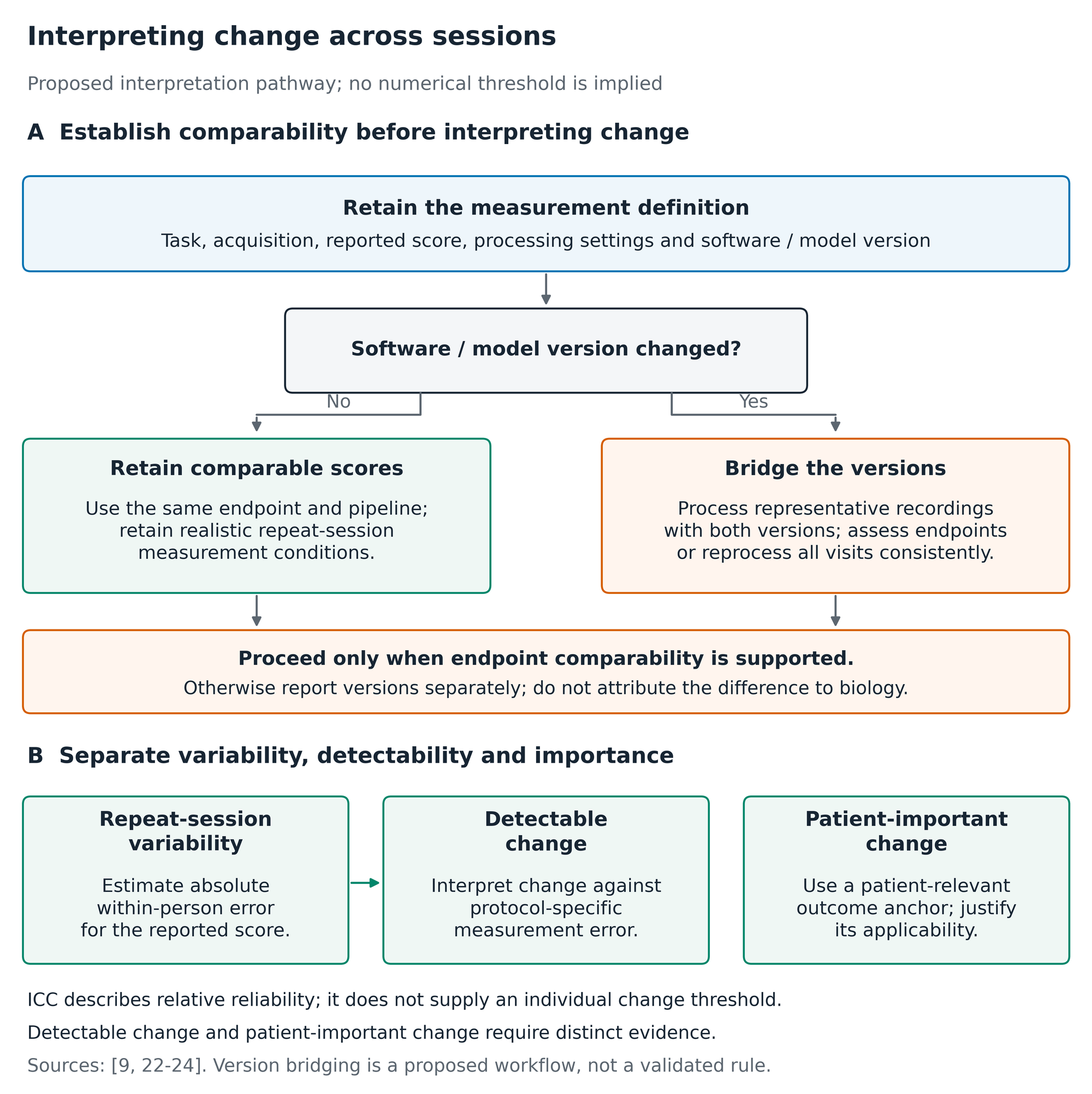
Reliability reporting should identify the intraclass correlation coefficient model, agreement or consistency definition, single-measure or averaged-measure target, and uncertainty interval [22]. An ICC can be high in a heterogeneous sample despite substantial absolute error. It is therefore insufficient for assessing whether a small change in one individual is distinguishable from measurement variability. Report absolute within-person error and inspect whether it varies by baseline value, task difficulty, or impairment severity.
Under a conventional model with approximately normal, independent, equally variable errors at two occasions and no unaccounted systematic shift, a 95% minimal detectable change is , where SEM is the standard error of measurement for the relevant protocol [23]. If the reported score averages repetitions, its SEM must correspond to that same score. Correlated occasion errors, learning effects, heteroscedasticity, or altered acquisition can invalidate the simple expression. Detectable change describes measurement uncertainty; it does not establish the magnitude that matters to a patient or athlete.
Clinically important change requires a separate justification linked to the intended outcome. A statistically distinguishable angle change may be clinically trivial, while a clinically valuable improvement may remain uncertain in a noisy instrument. Schwartz and colleagues demonstrated an approach to separating sources of gait variability and incorporating measurement uncertainty into interpretation [24]. For markerless monitoring, analogous repeat-session designs should retain realistic variation in operators and setup. Standardising chair height, walking speed, footwear, and instructions can improve interpretability, but a study must also establish whether those constraints are achievable where the method will be used.
Waveform and event analyses should complement discrete peaks when the interpretation depends on timing or movement strategy. A low average waveform error can conceal a biased impact peak, while aggressive temporal alignment can remove a real timing difference. Conversely, testing every time point independently without addressing multiplicity can exaggerate evidence of difference. Report the event-detection procedure, alignment rule, and prespecified waveform question. Neither a statistically significant difference nor a nonsignificant comparison establishes clinical non-equivalence or equivalence without a justified tolerance and adequate precision.
Generalisation and measurement coverageGeneralización y cobertura de la mediciónالتعميم وتغطية القياسसामान्यीकरण और माप-कवरेज
Acquisition conditions are part of the instrument. Camera placement, lens properties, illumination, motion blur, synchronization, image resolution, clothing, and occlusion should be described sufficiently for replication. Kanko and colleagues explicitly compared running measurements under different clothing conditions [25]. Such work provides a precedent for manipulating deployment factors, but successful performance with particular garments does not cover every fabric, fit, or movement. Studies should first isolate important factors, then evaluate realistic combinations in an independent setting.
Neural networks depend on training annotations and the range of appearances and movements represented during development [26]. Smooth trajectories can reflect a strong learned prior rather than faithful recovery of an unusual movement. Evaluation should therefore examine not only average error but also the preservation of clinically relevant extremes and between-person variation. The clinical cerebral palsy findings illustrate this concern without proving a single computational cause [12,13]. Investigators should avoid attributing every subgroup difference to a demographic characteristic when visibility, task execution, body dimensions, and model structure may contribute.
Machine-learning guidance in movement biomechanics emphasises separating development from evaluation and avoiding information leakage [27]. Adjacent frames, repeated trials, or both limbs from the same person should not be distributed across training and test sets when the claim concerns generalisation to new people. Tuning on an external site’s data makes that site part of model development unless a separate untouched evaluation is retained. Report what was pretrained, retrained, calibrated, and selected, including any human corrections informed by the reference outcome.
Measurement coverage should accompany conditional accuracy. A proposed reporting structure is the number of eligible visits, attempted acquisitions, technically adequate recordings, successfully processed outputs, and interpretable clinical reports, with reasons for each loss. Failures may be associated with the most severe impairment or the greatest need for assistance. Complete-case error alone can therefore give an unduly favourable picture. If no output can be produced, reporting the failure is more informative than silently treating it as normal movement or imputing a plausible curve.
Equity claims require adequate data, explicit comparisons, and uncertainty. It is useful to examine performance across relevant body dimensions, age ranges, skin appearance under the actual lighting, clothing practices, and use of assistive devices. However, a small study cannot establish demographic fairness through nonsignificant subgroup tests. Multicentre collaborations can retain a common core protocol while testing locally relevant conditions. They should report site-specific coverage and uncertainty, as a pooled average can obscure systematic failure at a less-resourced site. Identifiable video also requires appropriate consent, access control, and a reproducible plan for sharing derived data when unrestricted video sharing is unsuitable.
A proposed pathway from measurement to clinical useUna vía propuesta desde la medición hasta el uso clínicoمسار مقترح من القياس إلى الاستخدام السريريमाप से नैदानिक उपयोग तक एक प्रस्तावित मार्ग
The V3 framework distinguishes verification, analytical validation, and clinical validation for biometric monitoring technologies [28]. For movement analysis, these categories can be operationalised by specifying the anatomical quantity and decision at each stage. Verification concerns correct implementation and acquisition. Analytical validation concerns the measurement or estimate against an appropriate reference. Clinical validation concerns the interpretation in the intended population and context. Table 3 adds external evaluation, longitudinal use, and prospective workflow assessment as practical components of this pathway.
| Stage | Evidence to collect | Reporting requirement |
|---|---|---|
| Intended use | Population, task, output, setting, operator, intended action | State the decision and consequences of error before choosing tolerances |
| Technical verification | Calibration, synchronization, unit tests, anatomical conventions, processing reproducibility | Identify hardware, model, software version, and all manual interventions |
| Analytical validation | Paired reference data, bias, absolute error, agreement limits, events and waveforms | Describe reference uncertainty and use the appropriate clustered analysis |
| External evaluation | New people, operators, sites, and realistic perturbations | Report coverage, subgroup uncertainty, and whether any local tuning occurred |
| Longitudinal evaluation | Repeat sessions, practical SEM, version bridging, clinically relevant anchors | Separate detectable change from important change and individual from group inference |
| Decision evaluation | Interpretation, management changes, overrides, burden, unintended consequences | Test whether using the measurement improves an outcome relevant to the intended use |
| Ongoing monitoring | Acquisition failures, distribution changes, software updates, reproducibility | Define when a result is withheld, reviewed, reacquired, or reprocessed |
A feasible prospective validation study should designate one primary output and the precision needed for its intended use. Participants should represent the clinical service, including relevant impairment and assistance rather than only convenient healthy volunteers. Repeated sessions should reproduce the complete setup process, and operator variation should be included when the service relies on multiple operators. A synchronized reference subset can test analytical agreement while the larger deployment cohort tests coverage and feasibility. Sample size should follow the required precision of agreement limits, failure rates, or decision performance; a generic minimum number of participants is not defensible for every question.
Before analysis, investigators should specify exclusion rules, minimum recording quality, treatment of partial trials, missing-output handling, primary aggregation, and the boundary between calibration and evaluation. A protocol should retain unsuccessful visits in the feasibility denominator even when they cannot contribute numerical agreement data. Data-driven threshold selection should occur within development data and be evaluated independently. Reporting the full sequence prevents a flexible processing pipeline from turning repeated post hoc choices into an apparently prespecified clinical test.
The pathway branches when the output becomes a clinical prediction model. TRIPOD+AI supports transparent reporting of prediction-model development and evaluation [29], while PROBAST+AI addresses quality, risk of bias, and applicability [30]. These tools do not replace instrument-agreement methods for angle estimation. If markerless outputs feed a diagnostic or prognostic rule, both the measurement stage and the downstream rule require evaluation. A model that predicts future injury additionally needs longitudinal outcomes, representative exposure, calibration, and independent validation; a movement feature’s mechanical plausibility is insufficient.
Clinical usefulness also depends on how people act on the report. DECIDE-AI provides reporting guidance for early clinical evaluation of AI-supported decisions [31]. An analogous movement-analysis evaluation should record whether clinicians understand uncertainty, when they disagree with or override outputs, and whether the information changes management. Changes in management are intermediate outcomes. Demonstrating benefit may require a comparative design assessing function, symptoms, participation, resource use, or another prespecified outcome. The size and design of that evaluation should follow the proposed clinical claim.
Longitudinal interpretation and software changeInterpretación longitudinal y cambios de softwareالتفسير الطولي وتغيّر البرمجياتअनुदैर्ध्य व्याख्या और सॉफ़्टवेयर-परिवर्तन
Every result should remain linked to its raw recording, acquisition configuration, processing settings, and model version. Software updates can change estimated joint locations, segment definitions, or derived scores without any biological change. A bridge evaluation should process representative recordings through both versions and examine agreement in the endpoints used for follow-up. A fixed numerical correction is inadequate when the change is task dependent or nonlinear. Reprocessing all visits may be justified, but original and revised outputs should remain distinguishable.
Figure 4 separates measurement variability, detectable change and patient-important change while showing the version-comparison step needed for longitudinal interpretation.
Consider a proposed service monitoring peak knee flexion during repeated sit-to-stand. The service would define the chair height, foot placement, instructions, aggregation rule, camera setup, and handling of hand support. Repeat visits would estimate the uncertainty of the actual reported score, and a separate outcome anchor would address clinical relevance. If the recording excludes the feet or the participant uses an unmodelled support, the report may need to withhold the affected interpretation. This example specifies a study and quality-control architecture; it does not establish that knee flexion alone represents recovery or supply a validated threshold.
Quality control should communicate a concrete action. A report can provide an estimate with its applicable measurement uncertainty, identify the relevant task and version, and state why an output is unavailable. Automated abstention may reduce misleading interpretations, but it also lowers coverage and can inconvenience patients. Its performance should therefore be measured rather than assumed beneficial. Confidence supplied by a pose-estimation network should not be relabelled as a calibrated clinical probability unless that calibration has been demonstrated for the intended outcome.
Limitations and research prioritiesLimitaciones y prioridades de investigaciónالقيود وأولويات البحثसीमाएँ और शोध-प्राथमिकताएँ
This review’s purposive selection and unequal access to full texts limit its completeness. The evidence map concentrates on lower-limb gait and selected functional tasks, includes both developer-associated and independent studies, and does not establish a hierarchy of systems. Several recent clinical results were available only at abstract level. The proposed pathway expresses a reasoned methodological position rather than a validated intervention, professional consensus, or regulatory standard.
The most useful next studies would connect upstream image and anatomical uncertainty to downstream decision error; evaluate clinically unusual movements in independent settings; compare failures and successful outputs using transparent denominators; and establish longitudinal measurement properties under actual service conditions. Prospective evaluations should investigate whether the measurement adds useful information beyond existing assessment. Studies with accessible cameras should also measure staff time, repeat visits, computing requirements, and interpretation burden, because low acquisition cost alone does not establish a sustainable clinical service.
ConclusionConclusiónالخلاصةनिष्कर्ष
Markerless motion capture can broaden access to quantitative movement analysis, but validation belongs to a specified output, population, task, setting, and decision. Empirical studies support selected applications while revealing clinically relevant limits that are obscured by pooled accuracy or repeatability statistics. Credible translation requires anatomical clarity, reference-aware agreement analysis, appropriate treatment of clustered data, transparent failure reporting, and model-specific kinetic validation. Separating measurement performance from meaningful change and clinical usefulness allows researchers to make precise claims and clinicians to interpret estimates within their demonstrated limits.
Author InformationInformación de los autoresمعلومات المؤلفينलेखक-जानकारी
DeclarationsDeclaracionesالإقراراتघोषणाएँ
No specific funding was received for this work.
The authors declare no competing interests.
This review synthesises published literature. It reports no new participant recruitment, identifiable participant material or individual-level experimental data collection; ethical approval was therefore not required.
No new experimental dataset was generated. Sources are identified in the reference list. Source-verification and search records are held by the JMMBS editorial office and are available on reasonable request.
AI-assisted tools supported literature discovery, language editing, reference checking and document preparation. No participant data or experimental results were generated. The authors reviewed and verified the content and take full responsibility for the published article.
Swapnesh Tiwari, MD, MS — via the JMMBS editorial office, info@jmmbs.org.
ReferencesReferenciasالمراجعसंदर्भ
- Mündermann L, Corazza S, Andriacchi TP. The evolution of methods for the capture of human movement leading to markerless motion capture for biomechanical applications. J Neuroeng Rehabil. 2006;3:6. https://doi.org/10.1186/1743-0003-3-6
- Corazza S, Mündermann L, Chaudhari AM, Demattio T, Cobelli C, Andriacchi TP. A markerless motion capture system to study musculoskeletal biomechanics: visual hull and simulated annealing approach. Ann Biomed Eng. 2006;34(6):1019–1029. https://doi.org/10.1007/s10439-006-9122-8
- Uhlrich SD, Falisse A, Kidziński Ł, Muccini J, Ko M, Chaudhari AS, et al. OpenCap: Human movement dynamics from smartphone videos. PLoS Comput Biol. 2023;19(10):e1011462. https://doi.org/10.1371/journal.pcbi.1011462
- Wade L, Needham L, McGuigan P, Bilzon J. Applications and limitations of current markerless motion capture methods for clinical gait biomechanics. PeerJ. 2022;10:e12995. https://doi.org/10.7717/peerj.12995
- Wu G, Siegler S, Allard P, Kirtley C, Leardini A, Rosenbaum D, et al. ISB recommendation on definitions of joint coordinate system of various joints for the reporting of human joint motion—part I: ankle, hip, and spine. J Biomech. 2002;35(4):543–548. https://doi.org/10.1016/S0021-9290(01)00222-6
- Needham L, Evans M, Cosker DP, Wade L, McGuigan PM, Bilzon JL, et al. The accuracy of several pose estimation methods for 3D joint centre localisation. Sci Rep. 2021;11:20673. https://doi.org/10.1038/s41598-021-00212-x
- Stenum J, Rossi C, Roemmich RT. Two-dimensional video-based analysis of human gait using pose estimation. PLoS Comput Biol. 2021;17(4):e1008935. https://doi.org/10.1371/journal.pcbi.1008935
- Kanko RM, Laende EK, Davis EM, Selbie WS, Deluzio KJ. Concurrent assessment of gait kinematics using marker-based and markerless motion capture. J Biomech. 2021;127:110665. https://doi.org/10.1016/j.jbiomech.2021.110665
- Kanko RM, Laende E, Selbie WS, Deluzio KJ. Inter-session repeatability of markerless motion capture gait kinematics. J Biomech. 2021;121:110422. https://doi.org/10.1016/j.jbiomech.2021.110422
- Nakano N, Sakura T, Ueda K, Omura L, Kimura A, Iino Y, et al. Evaluation of 3D markerless motion capture accuracy using OpenPose with multiple video cameras. Front Sports Act Living. 2020;2:50. https://doi.org/10.3389/fspor.2020.00050
- Svetek A, Morgan K, Burland J, Glaviano NR. Validation of OpenCap on lower extremity kinematics during functional tasks. J Biomech. 2025;183:112602. https://doi.org/10.1016/j.jbiomech.2025.112602
- Wishaupt K, Schallig W, van Dorst MH, Buizer AI, van der Krogt MM. The applicability of markerless motion capture for clinical gait analysis in children with cerebral palsy. Sci Rep. 2024;14:11910. https://doi.org/10.1038/s41598-024-62119-7
- Chafetz RS, Warshauer S, Waldron S, Kruger KM, Donahue S, Bauer JP, et al. Validation, characterization, and utility of markerless motion capture in a large cohort of pediatric patients with complex gait patterns. J Biomech. 2026;204:113359. https://doi.org/10.1016/j.jbiomech.2026.113359
- Outerleys J, Laende E, Malek M, Civiero S, Madden K, Ruder M, et al. Clinical integration of markerless motion capture: A multicentre study of gait in knee osteoarthritis. J Biomech. 2025;192:112952. https://doi.org/10.1016/j.jbiomech.2025.112952
- Vellucci CL, Ratke EJ, Guleria A, Beaudette SM. A deep-learning pipeline to extract clinical gait metrics from single-camera recordings. J Biomech. 2026;207:113573. https://doi.org/10.1016/j.jbiomech.2026.113573
- Reinschmidt C, van den Bogert AJ, Nigg BM, Lundberg A, Murphy N. Effect of skin movement on the analysis of skeletal knee joint motion during running. J Biomech. 1997;30(7):729–732. https://doi.org/10.1016/S0021-9290(97)00001-8
- Delp SL, Anderson FC, Arnold AS, Loan P, Habib A, John CT, et al. OpenSim: open-source software to create and analyze dynamic simulations of movement. IEEE Trans Biomed Eng. 2007;54(11):1940–1950. https://doi.org/10.1109/TBME.2007.901024
- Seth A, Hicks JL, Uchida TK, Habib A, Dembia CL, Dunne JJ, et al. OpenSim: Simulating musculoskeletal dynamics and neuromuscular control to study human and animal movement. PLoS Comput Biol. 2018;14(7):e1006223. https://doi.org/10.1371/journal.pcbi.1006223
- Hicks JL, Uchida TK, Seth A, Rajagopal A, Delp SL. Is my model good enough? Best practices for verification and validation of musculoskeletal models and simulations of movement. J Biomech Eng. 2015;137(2):020905. https://doi.org/10.1115/1.4029304
- Bland JM, Altman DG. Statistical methods for assessing agreement between two methods of clinical measurement. Lancet. 1986;1(8476):307–310. https://doi.org/10.1016/S0140-6736(86)90837-8
- Bland JM, Altman DG. Agreement between methods of measurement with multiple observations per individual. J Biopharm Stat. 2007;17(4):571–582. https://doi.org/10.1080/10543400701329422
- Koo TK, Li MY. A guideline of selecting and reporting intraclass correlation coefficients for reliability research. J Chiropr Med. 2016;15(2):155–163. https://doi.org/10.1016/j.jcm.2016.02.012
- Weir JP. Quantifying test-retest reliability using the intraclass correlation coefficient and the SEM. J Strength Cond Res. 2005;19(1):231–240. https://doi.org/10.1519/15184.1
- Schwartz MH, Trost JP, Wervey RA. Measurement and management of errors in quantitative gait data. Gait Posture. 2004;20(2):196–203. https://doi.org/10.1016/j.gaitpost.2003.09.011
- Kanko RM, Outerleys JB, Laende EK, Selbie WS, Deluzio KJ. Comparison of concurrent and asynchronous running kinematics and kinetics from marker-based and markerless motion capture under varying clothing conditions. J Appl Biomech. 2024;40(2):129–137. https://doi.org/10.1123/jab.2023-0069
- Cronin NJ. Using deep neural networks for kinematic analysis: Challenges and opportunities. J Biomech. 2021;123:110460. https://doi.org/10.1016/j.jbiomech.2021.110460
- Halilaj E, Rajagopal A, Fiterau M, Hicks JL, Hastie TJ, Delp SL. Machine learning in human movement biomechanics: Best practices, common pitfalls, and new opportunities. J Biomech. 2018;81:1–11. https://doi.org/10.1016/j.jbiomech.2018.09.009
- Goldsack JC, Coravos A, Bakker JP, Bent B, Dowling AV, Fitzer-Attas C, et al. Verification, analytical validation, and clinical validation (V3): the foundation of determining fit-for-purpose for biometric monitoring technologies (BioMeTs). NPJ Digit Med. 2020;3:55. https://doi.org/10.1038/s41746-020-0260-4
- Collins GS, Moons KGM, Dhiman P, Riley RD, Beam AL, Van Calster B, et al. TRIPOD+AI statement: updated guidance for reporting clinical prediction models that use regression or machine learning methods. BMJ. 2024;385:e078378. https://doi.org/10.1136/bmj-2023-078378
- Moons KGM, Damen JAA, Kaul T, Hooft L, Andaur Navarro C, Dhiman P, et al. PROBAST+AI: an updated quality, risk of bias, and applicability assessment tool for prediction models using regression or artificial intelligence methods. BMJ. 2025;388:e082505. https://doi.org/10.1136/bmj-2024-082505
- Vasey B, Nagendran M, Campbell B, Clifton DA, Collins GS, Denaxas S, et al. Reporting guideline for the early-stage clinical evaluation of decision support systems driven by artificial intelligence: DECIDE-AI. Nat Med. 2022;28(5):924–933. https://doi.org/10.1038/s41591-022-01772-9